- Details
- By Native News Online Staff
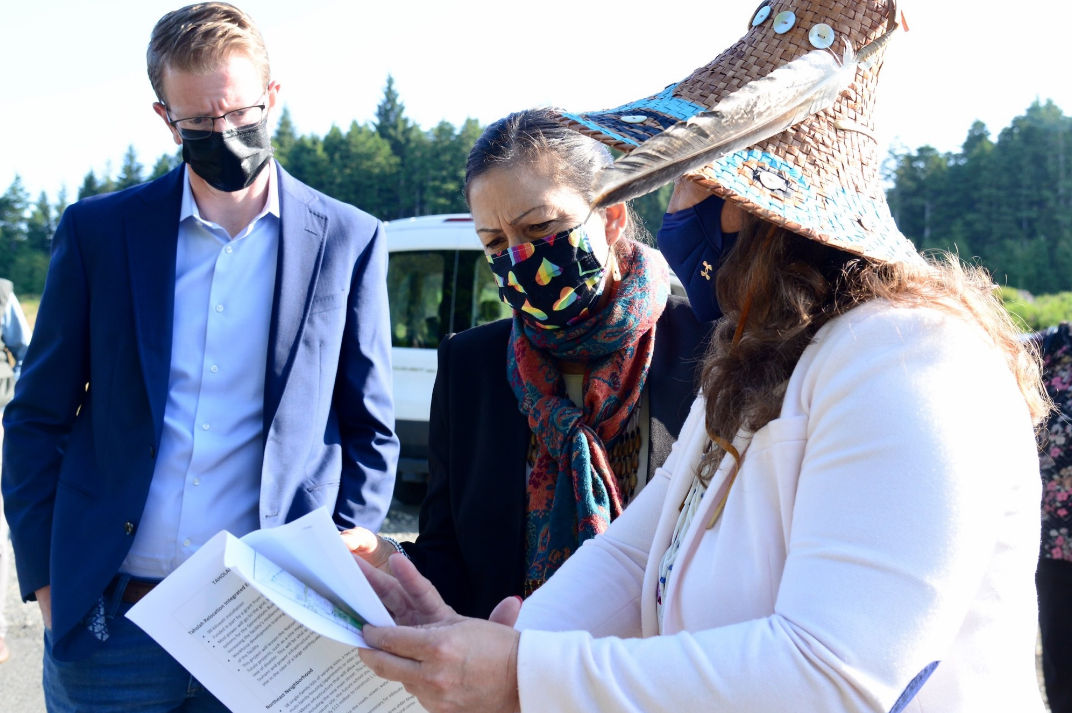
TAHOLAH, Wash. — Interior Secretary Deb Haaland (Laguna Pueblo) visited the Quinault Indian Nation in Washington state on Monday.
While there, she and Rep. Derek Kilmer (D-WA) met with leaders of the Quileute Tribe, Hoh Tribe, Makah Tribe, Lower Elwha Klallam Tribe, Jamestown S’Klallam Tribe, Port Gamble S’Klallam Tribe, Suquamish Tribe, Skokomish Tribe, Squaxin Island Tribe, Chehalis Tribe and Puyallup Tribe.
Want more Native News? Get the free daily newsletter today.
Sec. Haaland discussed the Biden-Harris administration’ investments in tribal communities, including broadband internet and climate resilience projects.
Leaders of the Quinault Indian Nation invited Sec. Haaland to the Village of Tahaloh, which is being relocated to higher ground because the village faces the constant threat from storm surges and flooding. Taholah is located in northwestern Washington on the Pacific Ocean coast.
“As coastal communities face the increasing threat of rising seas, coastal erosion and storm surges, our focus must be on bolstering climate resilience,” Sec. Haaland said. “The investments discussed today are central to the Biden-Harris administration’s all-of-government approach to building more resilient communities and protecting the natural environment.”
National Congress of American Indians (NCAI) President Fawn Sharp serves as vice chair of the Quinault Indian Nation. Sharp and other Quinault Indian Nation leaders gave Sec. Haaland and Rep. Kilmer a tour.
“It is truly a historic moment for our tribes to know that the administration in Washington, D.C. cares enough about tribes to send their delegation here to talk with us and hear our concerns, to hear what matters to tribes. And that’s our people, our safety, our health, our environment, our homes,” Quinault Indian Nation President Guy Capoeman said. “Moving from the lower villages to up on the hill will protect our membership.”
Donate today so Native News is free for all readers.
Sec. Haaland said that the bipartisan infrastructure deal that is expected to pass the Senate early Tuesday would allocate resources to assist tribal communities threatened by climate change.
The Bipartisan Infrastructure Deal includes a $466 million investment for the Bureau of Indian Affairs, including funds for transition and relocation assistance to support community-led transitions. The investments include:
- $216 million for Tribal climate resilience, adaptation and community relocation planning, design and implementation of projects which address the varying climate challenges facing Tribal communities across the country.
- $250 million for construction, repair, improvement and maintenance of irrigation and power systems, safety of dams, water sanitation and other facilities.
Sec. Haaland also highlighted federal investments to close the digital divide in Indian Country and ensure tribal communities have access to broadband so that they can better participate in today’s economy.
Earlier this year, Vice President Kamala Harris, Secretary of Commerce Gina Raimondo and Secretary Haaland announced the availability of nearly $1 billion in U.S. Department of Commerce’s National Telecommunications and Information Administration (NTIA) grants to expand broadband access and adoption on tribal land.
A coalition of federal agencies are working together to address the digital divide in Indian Country. This year, the Interior Department and the Institute of Museum and Library Services are partnering with the U.S. Department of Agriculture’s Rural Development Service and the NTIA for the 2021 National Tribal Broadband Summit, taking place throughout the month of September as a virtual event due to the Covid-19 pandemic.
More Stories Like This
Gwich'in Tribal Governments Submit Comments Challenging Fish and Wildlife Service's Inadequate Environmental Review of Arctic Refuge Snow RoadRappahannock Tribe Challenges 9M-Gallon Water Plan
Feds release draft long-term plans for Colorado River management
Apache Leader Walks 60 Miles to Court Hearing That Will Decide Fate of Sacred Oak Flat
Rappahannock Tribe Raises Sovereignty and Environmental Concerns Over Caroline County Water Permit
Help us defend tribal sovereignty.
At Native News Online, our mission is rooted in telling the stories that strengthen sovereignty and uplift Indigenous voices — not just at year’s end, but every single day.
Because of your generosity last year, we were able to keep our reporters on the ground in tribal communities, at national gatherings and in the halls of Congress — covering the issues that matter most to Indian Country: sovereignty, culture, education, health and economic opportunity.
That support sustained us through a tough year in 2025. Now, as we look to the year ahead, we need your help right now to ensure warrior journalism remains strong — reporting that defends tribal sovereignty, amplifies Native truth, and holds power accountable.
 The stakes couldn't be higher. Your support keeps Native voices heard, Native stories told and Native sovereignty defended.
Stand with Warrior Journalism today.
Levi Rickert (Potawatomi), Editor & Publisher