



- Details
- By Donovan Quintero
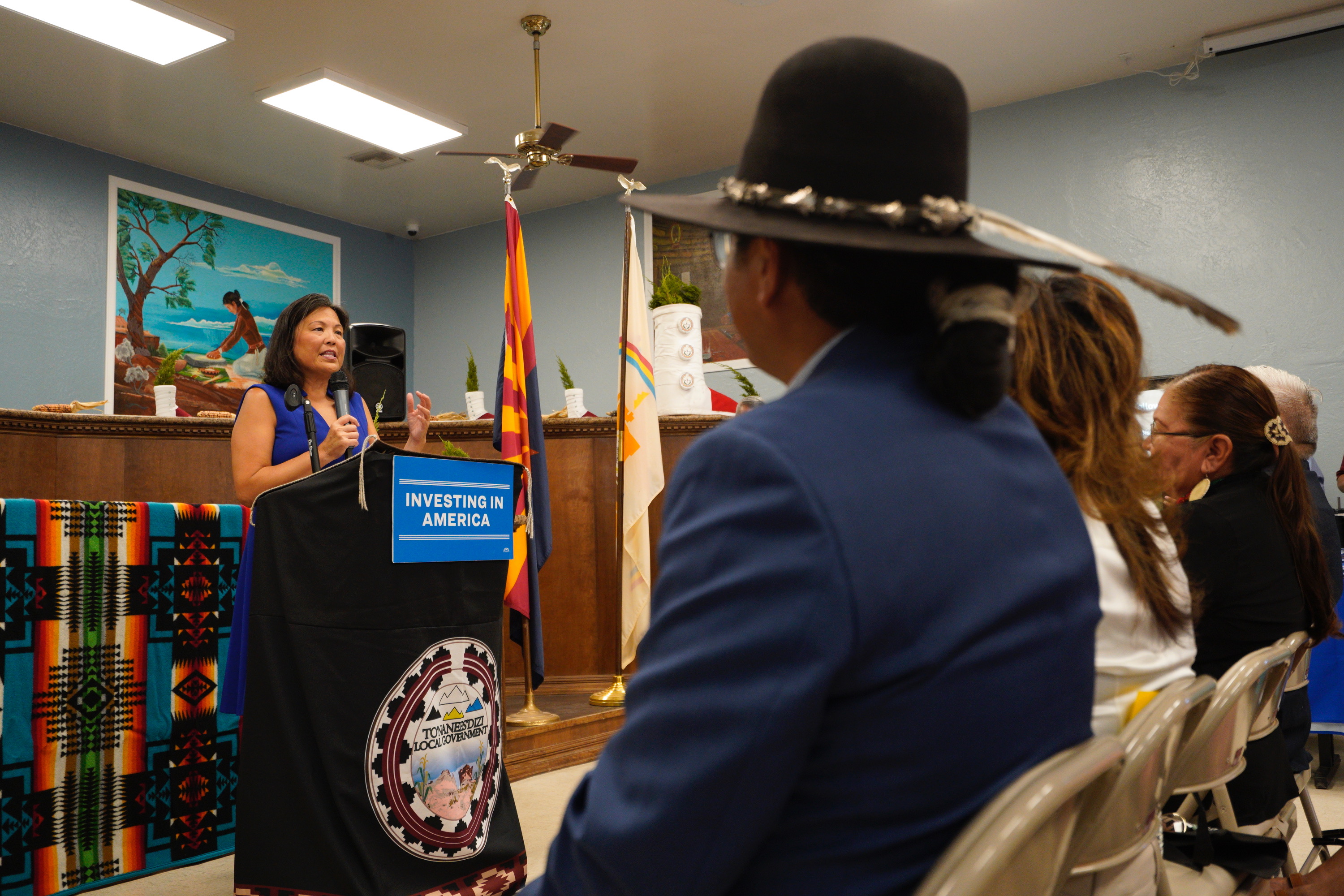
TUBA CITY, Ariz. — While her visit was short and simple, U.S. Department of Labor Acting Secretary Julie Su, along with Navajo Nation President Buu Nygren, wasted no time talking about several possible solutions that could spark an economic spark in the Navajo Nation.
President Nygren met with Secretary Su at the job fair to address worker safety, utilizing the Workforce Innovation and Opportunity Act (WIOA), and improving gathering statistics, all of which could aid in economic development.

WIOA, as reported by the U.S. Department of Education, aims to assist job seekers in securing employment, education, training, and support services necessary for success in the labor market, while also connecting employers with the skilled workforce required to compete in the global economy.
Nygren thanked the Secretary for providing $13 million in funding to the Navajo Nation Department of Workforce Development. He said the funding would be used to help Navajo people living on and off the reservation, looking for employment, or their training and education.
“(The) $13 million is gonna go a long way because we know that for our community to stand up and rise, you need strong economic activity,” said President Nygren. “We need jobs, we need small businesses, we need access to financing, and we need leadership to support and move some of those initiatives.”
In the Navajo Nation community of Tuba City, Arizona, Tuba City Chapter Executive Manager Durann Begay said the small town has four primary employers: the Tuba City Regional Health Care, the schools, the Navajo Tribal Utility Authority, and the Navajo Nation government. While the workforce might seem strong, the lack of housing has forced employees to find housing elsewhere.
“We have a lot of employees that are commuting in because there's no housing available,” said Begay. “Even in our local hospital, it's very hard for them to employ doctors and nurses. They have to house them in Flagstaff and they commute in.”
Tribes have had no luck navigating a complex legal web that has made it nearly impossible to use their trust lands to benefit their people. According to a 1949 federal law, which states “all land within the limits of any of the 325 Indian reservations under the jurisdiction of the tribe, allotted lands, and dependent Indian communities,” the law has prevented tribes from selling, using it as collateral, or encumbering it for a mortgage.
Overall, tribes exercise their sovereignty over more than 60 million acres of land.
Tuba City Chapter Vice President Myra Begay echoed Begay’s concerns and said a lack of housing was an issue.
“I think housing is probably the biggest obstacle and I think around the entire reservation, the unemployment rate is fairly high, so we do need more jobs, " said Myra Begay.
Secretary Su acknowledged that part of the struggle when jobs were created, the commute was too far for people to make.
“Fundamentally, it's about the need for good jobs and investments will help to create those jobs, right? We care not just about the number of jobs that get created, but the quality of those jobs,” said Su. “A job should lift people out of poverty, allow you to do one job and make a living, and be able to spend time with your children.”
Navajo Nation Council Delegate Germaine Simonson addressed another challenge: operating a business with no readily available access to resources, banks, and accountants.
“The support systems that help you do business so you can stay focused on the business, we just don't have those. So, it is incredibly difficult,” said delegate Simonson.
She suggests that new rules and regulations need to be created that allow a budding business to slowly grow for five years.
“It's like an incubation period, like where you're focusing on your business, instead of all the paperwork and other things that come along. I hope we get there sometime soon,” she said.
Before the COVID-19 pandemic, tribal governments directly supported a workforce of 350,000 jobs, indirectly facilitated an additional 600,000 jobs, and contributed $40 billion annually in wages and benefits, along with an additional $9 billion to state and regional economies, according to the Economic Policy Institute.
More Stories Like This
Native News Weekly (August 25, 2024): D.C. BriefsUS Presidents in Their Own Words Concerning American Indians
Hozhonigo Institute Helps Drive $34.5M in Grant Pipeline for Tribal Communities
Torres, LaMalfa Lead Push to Safeguard Culturally Important Tribal Seed Varieties
Navajo Mother Welcomes Federal Charges in 2020 Killing of Her Son
Help us defend tribal sovereignty.
At Native News Online, our mission is rooted in telling the stories that strengthen sovereignty and uplift Indigenous voices — not just at year’s end, but every single day.
Because of your generosity last year, we were able to keep our reporters on the ground in tribal communities, at national gatherings and in the halls of Congress — covering the issues that matter most to Indian Country: sovereignty, culture, education, health and economic opportunity.
That support sustained us through a tough year in 2025. Now, as we look to the year ahead, we need your help right now to ensure warrior journalism remains strong — reporting that defends tribal sovereignty, amplifies Native truth, and holds power accountable.
 The stakes couldn't be higher. Your support keeps Native voices heard, Native stories told and Native sovereignty defended.
Stand with Warrior Journalism today.
Levi Rickert (Potawatomi), Editor & Publisher