- Details
- By Levi Rickert
Opinion. This fall, as I’ve introduced myself to college students during lectures, I begin by saying, “I’m here because my grandmother survived an Indian boarding school.”
It’s more than an introduction — it’s the truth. I exist because my grandmother didn’t die at the boarding school where she was sent as a child.
My grandmother, Ellen (Moore) Whitepigeon, a citizen of the Prairie Band Potawatomi Nation, was taken from her home in Mayetta, Kan, and sent 250 miles away to the Genoa U.S. Indian Industrial School in Nebraska.

While young Ellen survived, 87 Native children who attended Genoa during its 50 years of operation never made it home. She eventually returned to Mayetta, and a few years later, my grandfather, Levi Whitepigeon, traveled from Michigan to marry her. They settled in Grand Rapids and spent 50 years together before my grandfather passed two months after their golden wedding anniversary. Together they had 10 children — the roots of our family tree.
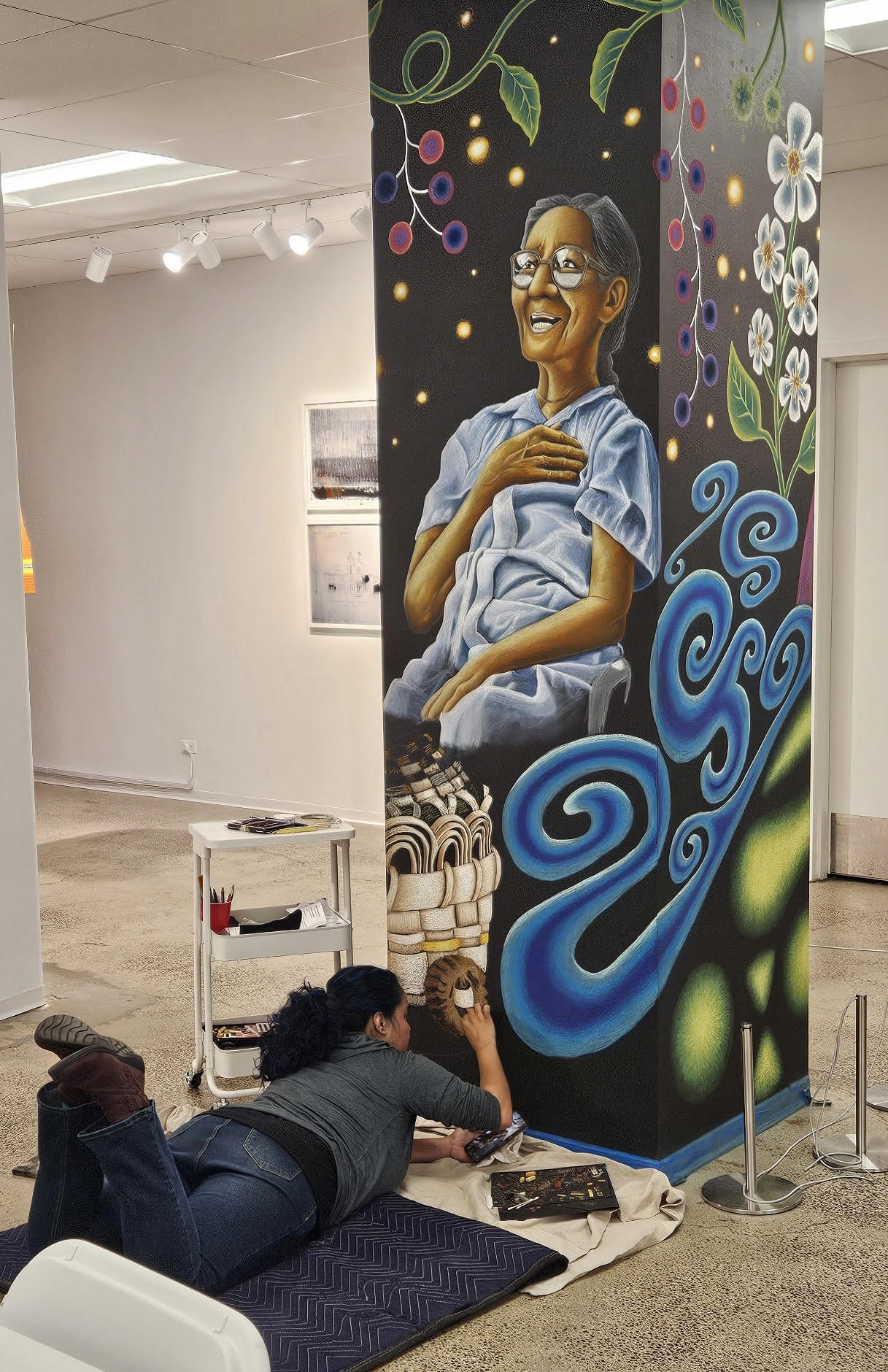
Grandma passed away 30 years ago. Last Wednesday, my daughter, artist Monica Rickert-Bolter, texted our family a photo of her latest rendering It features Grandma Whitepigeon. The rendering, called "Gizhénam: The Greats (WIP)," is part of the "Sight of Resistance" exhibition that is up until January 2026 at the Center for Native Futures in Chicago, a gallery Monica co-founded.
Monica’s text gave me goosebumps. Her rendering captures Grandma’s contagious laugh perfectly — a laugh I can still hear. The laugh on Grandma’s face took me back to my childhood, when the Whitepigeon family would picnic at local parks on Saturday evenings. Those gatherings were full of Indian humor and loud laughter.
One evening, a park attendant rolled up on a mower and barked, “You Indians can’t drink in this park.” There wasn’t a drop of alcohol among the Whitepigeons — just hamburgers, potato salad and faith. My grandparents were Pentecostals; I never once saw them drink. After the park employee left, Grandma laughed so hard it echoed across the park.
That laugh, that resilience — that’s what survival looks like.
Monica’s text came a few days before November, which is celebrated as Native American Heritage Month. It arrived one day after I spent time with Dr. Anton Treuer (White Earth Ojibwe), who visited Grand Valley State University to lecture.
During his lecture, he reminded us that storytelling and memory are powerful medicines. He spoke for almost two hours about his upbringing and how, during his youth, he never had a Native American teacher during his K–12 years. He didn’t have one until he was in a doctoral program. He reminisced that he seldom encountered a Native American professional as he grew up, though his mother became an attorney and then a tribal judge. He talked about how his mother and her law partner, who was also Native, were the only two Native professionals in the courtroom.
Listening to him, I thought about how resilient Native people are — and how hard we’ve worked to break barriers to advancement in today’s society where a lot more Natives hold professional positions.
Treuer also spoke about his extensive work in Native language revitalization. He said those who return to the languages stripped from our ancestors in Indian boarding schools find that embracing Native language is life-changing.
Seeing Monica’s painting of Grandma Whitepigeon and hearing Treuer’s lecture served as a fitting prelude to Native American Heritage Month. They both reminded me of our histories, our culture, and our truths.
Native American Heritage Month gives us a moment to pause, remember and celebrate who we are as Indigenous peoples. It’s not just about cultural pride or recognition — it’s about reflection.
For Native people, our very existence is an act of resilience. We descend from ancestors who endured policies designed to erase us — removal, forced assimilation, boarding schools and termination. Yet we’re still here. Our languages are being spoken again, our ceremonies practiced openly, and our children are growing up learning that being Native is a strength, not a burden.
This month invites us to honor that legacy. It’s a time to reflect on the courage of those who came before us — those who walked the Trail of Tears, who resisted at Wounded Knee, who survived the boarding schools and who stood up at Standing Rock. Each generation has carried the fire forward so the next could live with more dignity and pride.
But reflection doesn’t mean nostalgia. It means accountability — to continue what our ancestors started. We must confront the inequities that still persist: underfunded health care, the crisis of missing and murdered Indigenous people, threats to our land and water and the ongoing struggle for tribal sovereignty.
Resilience isn’t just surviving — it’s thriving in the face of systems that still test our endurance.
Native American Heritage Month is also a time to tell our own stories, on our own terms. For too long, others have defined us — through textbooks, mascots, and myths. Today, Native writers, artists and leaders are reclaiming the narrative, reminding the country that we are not relics of the past but living nations with wisdom and vision for the future.
When I think about resilience, I think of my grandmother, who survived Genoa. Because she lived, I live. Her laughter — even after what she endured — is the sound of resistance.
My daughter painting her great-grandmother is a testament to the strength Grandma Whitepigeon passed down through her genes.
Because she survived Genoa, Monica and I live.
During this Native American Heritage Month, let us all celebrate our ancestors and the strength they gave us.
Thayék gde nwéndëmen - We are all related.
More Stories Like This
The Lie We Keep Telling About Wounded KneeAnother Weapon of Mass Destruction
Colorado cannot heal until it confronts Sand Creek honestly
Native American Mothers Deserve to Live
Technology Rooted in Tradition is Strengthening Cherokee Nation
Help us defend tribal sovereignty.
At Native News Online, our mission is rooted in telling the stories that strengthen sovereignty and uplift Indigenous voices — not just at year’s end, but every single day.
Because of your generosity last year, we were able to keep our reporters on the ground in tribal communities, at national gatherings and in the halls of Congress — covering the issues that matter most to Indian Country: sovereignty, culture, education, health and economic opportunity.
That support sustained us through a tough year in 2025. Now, as we look to the year ahead, we need your help right now to ensure warrior journalism remains strong — reporting that defends tribal sovereignty, amplifies Native truth, and holds power accountable.
 The stakes couldn't be higher. Your support keeps Native voices heard, Native stories told and Native sovereignty defended.
Stand with Warrior Journalism today.
Levi Rickert (Potawatomi), Editor & Publisher