



- Details
- By Native StoryLab
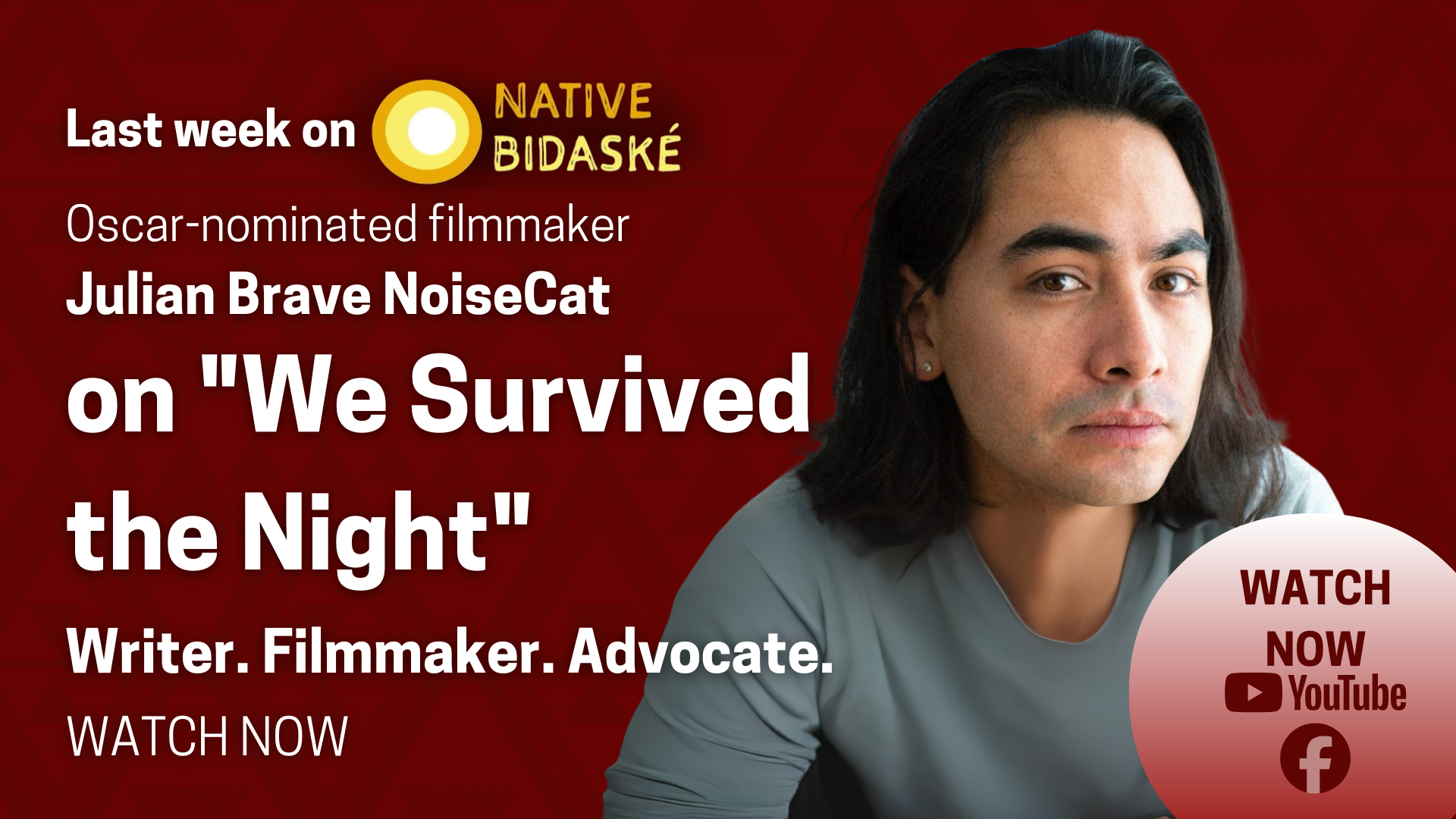
Last Friday, writer and filmmaker Julian Brave NoiseCat joined Native Bidaské host Levi Rickert to discuss his debut book, We Survived the Night, a deeply personal exploration of family, survival, and the stories that shaped his life.
NoiseCat, whose award-winning documentary Sugarcane earned an Oscar nomination for its searing look at Canada’s residential schools, says writing has always been central to understanding who he is.
“I always wanted to be a writer ever since I was a little kid,” he said. “My mom gave me Sherman Alexie books… I had all these questions about my identity, my culture, who I was, and reading and writing were a big part of how I sorted that all out.”
The title of his book, he explained, comes from his people’s language.
“In my people’s language, the way that we give the morning greeting is we say tsecwinucw-k, which translates to ‘you survived the night.’ It doesn’t actually mean ‘good morning.’”
That phrase carries generations of meaning, one that echoes through his grandmother’s humor and the collective endurance of his people. “There’s so much in our languages and worldview that gets at the truth of what it is to be Native…to be a survivor here on this land,” he said. “I wanted to try to convey that through my own family story and the story of Native people more broadly.”
Dancing, Storytelling, and Survival
Before he was an author or filmmaker, NoiseCat was a powwow dancer.
“That was my first thing that I ever found success in… my first paid writing gig was a very short-lived column for Indian Country Today called Powwow Reflections.”
Those experiences traveling to powwows and reconnecting with community laid the groundwork for the themes that run through We Survived the Night: kinship, humor, and endurance in the face of loss.
Writing the book, however, meant confronting painful truths about family and history.
“One of the things I did to write We Survived the Night was I actually moved in with my dad for two years,” he shared. “When you deprive an entire race of people the right to parent their own kids… our people, to a certain extent, unlearned how to do it. And that’s where I ended up with my dad.”
Through that experience, NoiseCat found deeper meaning in his people’s trickster stories—particularly those of Coyote.
“The Trickster Coyote is a complicated figure who’s also one of our first ancestors,” he said. “He’s a great creator and a great destroyer. He’s died and resurrected so many times that we didn’t even bother to keep count. Those stories get at something fundamentally true about our world.”
Weaving Old Stories Into New Truths
NoiseCat sees Indigenous oral traditions not as myths, but as living history.
“Our people have always considered these oral histories to be nonfiction,” he said. “They actually get at a lot of the truth of our world and how change happens.”
In We Survived the Night, those stories intertwine with his experiences as a journalist and political advocate, including his behind-the-scenes role in championing Deb Haaland’s historic nomination as the first Native American cabinet secretary.
“That’s another example of a contemporary trickster story,” he said. “We ended up convincing the powers that be to actually let it happen.”
Reclaiming the Story
For NoiseCat, centering Native people in their own narratives is both a cultural preservation and a political act.
“Native people are so often written out of the story… of the past, the present, and as a consequence, the future,” he said. “Part of the power of storytelling is that it gives people an understanding of where we’ve been, where we are, and where we’re going.”
He hopes We Survived the Night reaches readers across communities.
“I think that you don’t have to be Native to understand a story about fathers and sons… or about how history continues to shape our present,” he said. “It gets into some hard stuff, but also some funny bits too.”
Julian Brave NoiseCat’s We Survived the Night is available October 14 wherever books are sold.
📺 Watch the full Native Bidaské episode below.
Help us defend tribal sovereignty.
At Native News Online, our mission is rooted in telling the stories that strengthen sovereignty and uplift Indigenous voices — not just at year’s end, but every single day.
Because of your generosity last year, we were able to keep our reporters on the ground in tribal communities, at national gatherings and in the halls of Congress — covering the issues that matter most to Indian Country: sovereignty, culture, education, health and economic opportunity.
That support sustained us through a tough year in 2025. Now, as we look to the year ahead, we need your help right now to ensure warrior journalism remains strong — reporting that defends tribal sovereignty, amplifies Native truth, and holds power accountable.
 The stakes couldn't be higher. Your support keeps Native voices heard, Native stories told and Native sovereignty defended.
Stand with Warrior Journalism today.
Levi Rickert (Potawatomi), Editor & Publisher