- Details
- By Native News Online Staff
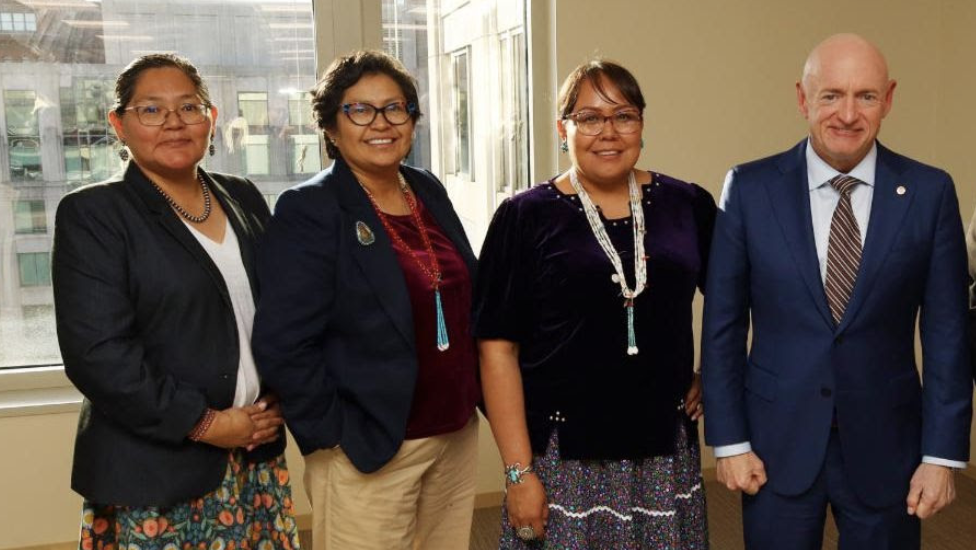
Members of the 25th Navajo Nation Council joined Hopi Chairman Tim Nuvangyaoma, U.S. Sen. Mark Kelly (D-AZ), and Rep. Eli Crane (R-AZ-) at a reception hosted by the Navajo Nation Washington Office to celebrate the introduction of the Northeastern Arizona Indian Water Rights Settlement in Congress.
In the Senate, the bill was introduced by Senators Mark Kelly and Ruben Gallego (D-AZ). In the House, it was brought forward by Representatives Juan Ciscomani (R-AZ), Greg Stanton (D-AZ), Eli Crane (R-AZ), Raúl Grijalva (D-AZ), David Schweikert (R-AZ), and Yassamin Ansari (D-AZ).

During the event, Speaker Curley underscored the settlement’s importance in securing a prosperous future for the Diné, Hopi, and San Juan Southern Paiute communities.
“It’s an exciting day to see this settlement introduced. It’s been a long time coming,” Speaker Curley said. “People doubted that three tribes could unite. This dispute was imposed on us, but with something as vital as water at stake, we came together—not for ourselves, but for our children.”
Hopi Chairman Nuvangyaoma echoed this sentiment, calling the settlement’s introduction a momentous occasion.
“I want to thank our Navajo and San Juan Southern Paiute relatives for setting aside differences, as we did as Hopi,” he said. “This settlement isn’t for us—it’s for the sustainability and survival of future generations. It must happen.”
The proposed settlement secures access to both Upper Basin Colorado River Water and Fourth Priority Lower Basin Colorado River Water—an allocation more secure than CAP Non-Indian Agricultural water. It also introduces greater flexibility by allowing Arizona water from New Mexico and Utah to be transported into the state, a practice currently restricted under the Law of the River. Additionally, it permits the use of Upper Basin Colorado River Water in Lower Basin communities and vice versa.
Beyond securing water access, the settlement would provide nearly $5 billion for water delivery infrastructure, enhancing long-term reliability and improving water management. These investments are crucial for Arizona communities that currently rely almost entirely on groundwater, offering an alternative source of clean drinking water.
“As you know, water is everything. Without it, we can’t grow crops or maintain a decent standard of living,” said Sen. Kelly. “We must build bipartisan support to make this happen.”
Council Delegates Cherilyn Yazzie, Carl R. Slater, Germaine Simonson, and Nathan Notah attended the reception in support of the initiative.
The 25th Navajo Nation Council extends its gratitude to congressional leaders for introducing the settlement and for their continued efforts to secure its passage.
More Stories Like This
Native News Weekly (August 25, 2024): D.C. BriefsScope Narrowed, Report Withheld: Questions Mount Over Michigan Boarding School Study
Zuni Youth Enrichment Project Announces Family Engagement Night and Spring Break Youth Programming
Next on Native Bidaské: Leonard Peltier Reflects on His First Year After Prison
Deb Haaland Rolls Out Affordability Agenda in Albuquerque
Help us defend tribal sovereignty.
At Native News Online, our mission is rooted in telling the stories that strengthen sovereignty and uplift Indigenous voices — not just at year’s end, but every single day.
Because of your generosity last year, we were able to keep our reporters on the ground in tribal communities, at national gatherings and in the halls of Congress — covering the issues that matter most to Indian Country: sovereignty, culture, education, health and economic opportunity.
That support sustained us through a tough year in 2025. Now, as we look to the year ahead, we need your help right now to ensure warrior journalism remains strong — reporting that defends tribal sovereignty, amplifies Native truth, and holds power accountable.
 The stakes couldn't be higher. Your support keeps Native voices heard, Native stories told and Native sovereignty defended.
Stand with Warrior Journalism today.
Levi Rickert (Potawatomi), Editor & Publisher