- Details
- By Native News Online Staff
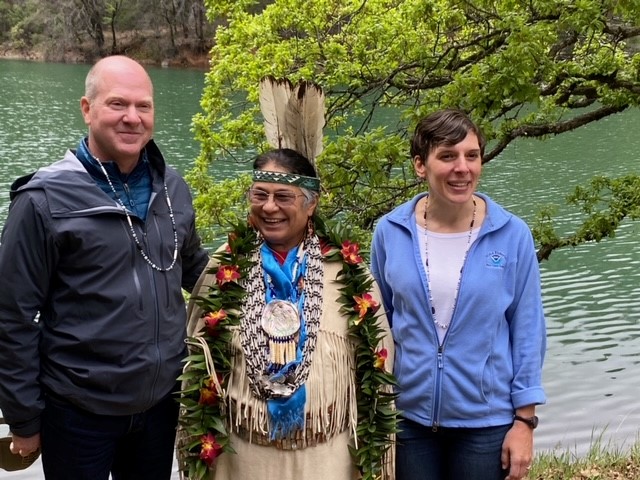
Winnemem Wintu Tribe, the California Department of Fish and Wildlife (CDFW) and National Oceanic Atmospheric Administration (NOAA) Fisheries signed agreements on May 1 to restore Chinook salmon to the mountains north of Redding, Calif.
The agreements support a joint effort to return Chinook salmon to their original spawning areas in cold mountain rivers now blocked by Shasta Reservoir in northern California. The agreement's goal is ecological and cultural restoration to renew fishing opportunities for the tribe that depended on the once-plentiful salmon for sustenance and cultural practices.

The tribe signed a co-management agreement with CDFW and a co-stewardship agreement with NOAA Fisheries, reflecting the way the two agencies describe accords with tribes. The agreements call for the agencies to include the tribe in decisions for salmon that have implications for the Winnemem Wintu.
Three years of drought have taken a toll on endangered winter-run Chinook salmon, which migrate and spawn in the lower Sacramento River. The river can warm to temperatures that are lethal to their eggs.
During the summer of 2022, the tribe joined state and federal agencies in pursuing urgent measures to improve the odds for winter-run Chinook salmon, including transporting 40,000 fertilized eggs to the cold McCloud River above Shasta Reservoir. Many hatched, swimming down the river for the first time since Shasta Dam was completed in the early 1940s. The tribe joined agency staff in collecting the juvenile fish before they reached the reservoir, which is populated with predators. Biologists then moved them downstream around the reservoir to continue to the ocean.
The new agreements call for the tribe to contribute traditional ecological knowledge, sharing insight as the tribe once did for Livingston Stone, who established the nation’s first Chinook salmon hatchery on the McCloud in 1872. The tribe’s oral history and Stone’s reports from the time recount the tribe’s deep cultural connection to winter-run Chinook salmon and practical knowledge of the species.
The agencies agreed to make the tribe a “co-equal decision-maker,” and CDFW has awarded a $2.3 million grant to support the tribe’s participation in salmon measures. Agencies also agreed to evaluate the potential reintroduction of Chinook salmon that were moved from the McCloud River in California to streams in New Zealand more than 100 years ago and have strong cultural and spiritual significance for the tribe.
“This is an historic agreement that moves us one step closer to our goal of returning wild salmon from New Zealand and creating a volitional passage around Shasta Dam,” Winnemem Wintu Chief Caleen Sisk said in a statement. “It’s incredible that we can now share this vision with CDFW and NOAA. We have a long way to go, but there are now more good people working on it.”
More Stories Like This
Klamath Indigenous Land Trust Purchases 10,000 Acres as Salmon ReturnTrump signs law that revokes some limits on drilling in Alaska’s National Petroleum Reserve
Southern Sierra Miwuk Nation Gets 900-Acres ofLand Back
Chilkat Indian Village Tells New Palmer Mine Owners They Are “Not Welcome” in Chilkat Valley
Tribes, Coastal Group Ask Army Corps to Revoke Permit for Texas Export Terminal
Help us defend tribal sovereignty.
At Native News Online, our mission is rooted in telling the stories that strengthen sovereignty and uplift Indigenous voices — not just at year’s end, but every single day.
Because of your generosity last year, we were able to keep our reporters on the ground in tribal communities, at national gatherings and in the halls of Congress — covering the issues that matter most to Indian Country: sovereignty, culture, education, health and economic opportunity.
That support sustained us through a tough year in 2025. Now, as we look to the year ahead, we need your help right now to ensure warrior journalism remains strong — reporting that defends tribal sovereignty, amplifies Native truth, and holds power accountable.
 The stakes couldn't be higher. Your support keeps Native voices heard, Native stories told and Native sovereignty defended.
Stand with Warrior Journalism today.
Levi Rickert (Potawatomi), Editor & Publisher