- Details
- By Levi Rickert
Opinion. Native News Online’s most read article this past week was not about the Missing and Murdered Indigenous People (MMIP) epidemic that has gripped Indian Country. Instead it was about South Dakota’s Governor Kristi Noem, who killed a dog because she deemed the pup untrainable to become a hunting dog.
Yes, she is the same Gov. Noem who has been banished from the tribal lands of several South Dakota tribes because she doesn’t give them respect and treats them with a paternalistic fashion.
On Friday, I thought about Noem as I listened to my governor, Gretchen Whitmer, address a crowd at the 2024 March for MMIP rally in Ah-Nab-Awen Park on the banks of the Owashtinong (Grand River) in Grand Rapids, Mich. Whitmer, who maintains a solid working relationship with the 12 federally recognized tribes in Michigan, was well received as the traditionalists say “in a good way.”
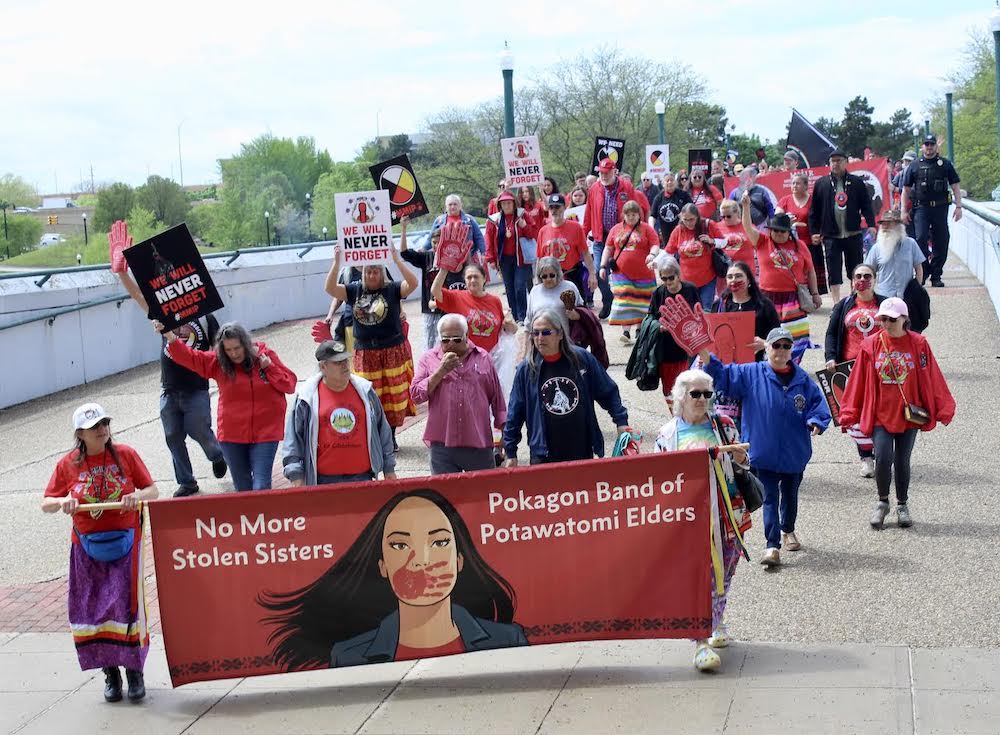
Let me paint you a picture: It was raining, but here was Whitmer, wearing a red blazer and standing under an umbrella as she addressed the crowd of several hundred people who were mostly wearing red shirts or black tops with red hands printed on them.

Three leaders from the state’s Potawatomi tribes — Chairman Jaime Stuck of the Nottawaseppi Huron Band of the Potawatomi; Chairman Bob Peters of the Match-E-Be-Nash-She-Wish Band of Pottawatomi Indians of Michigan (Gun Lake Tribe); and Chairwoman Rebecca Richards of Pokagon Band of Potawatomi — welcomed Whitmer, who presented each of them with a proclamation declaring May 5 as Missing and Murdered Indigenous People Day.
As I watched Whitmer talk with tribal leaders and tribal citizens, I thought the contrast between her and South Dakota’s Noem could not have been more stark. The difference goes far beyond the fact Noem is a Republican and Whitmer is a Democrat. Whitmer showed up for her state’s tribes and its citizens.
The gathering of hundreds of Anishinaabe and supporters at the MMIP march on Friday was one of dozens held around the country this weekend to commemorate May 5 as Missing or Murdered Indigenous Persons Awareness Day.
May 5 was not randomly chosen to bring awareness to the epidemic violence against Indigenous people. The date was selected because the Montana congressional delegation persuaded the U.S. Senate to pass a resolution declaring the national day of awareness because May 5 was the birthday of Hanna Harris, a 21-year-old member of the Northern Cheyenne tribe who went missing on July 4, 2013. Had she lived, Hannah would have turned 32 this May 5.
On Friday, the White House released a presidential proclamation for Missing or Murdered Indigenous Persons Awareness Day 2024. In the proclamation President Joe Biden wrote: "Across Indian Country, justice for the missing has been elusive for too long."
Sometimes I worry the repetitiveness of events such as MMIP gatherings with tribal citizens adorning red shirts or t-shirts with red hands on them could become almost cliché. Yet, I realize just how real the problem is among Indigenous people across Indian Country.
According to a July 2023 report by the Congressional Research Service, 82% of American Indian/Alaska Native (AI/AN) men reported experiencing violent victimizations in their lifetime. As of June 2023, 3.5% of the missing persons included in the National Missing and Unidentified Persons System were identified as AI/AN, which was more than three times their percentage in the U.S. population (1.1%).
After the rally on Friday, I spoke with Linda Sacks, a tribal citizen of the Cherokee Nation of Oklahoma. Sacks is the principal consultant for the California Native American Legislative Caucus, working in the office of California Assemblyman James C. Ramos, a lifelong resident of the San Manuel Indian Reservation and member of the Serrano/Cahuilla tribe who became the first California Native American state lawmaker in 2018.
Sacks shared with me how busy she had been, working to bring together MMIP events in Sacramento on May 1st that included a morning press conference, a MMIP hearing at the state capitol, and an evening candlelight vigil.
She also shared a tragic story of how her cousin was murdered back home in Tulsa two weeks ago. He was shot in the head by a non-Native man who is now behind bars. While she had mourned her cousin’s death, the enormity of what had happened within her own family really hit her hard on May 1.
“These events affect us,” Sacks told me. “Here I was working to bring together the events here in California and then it hit me — a murder happened in my own family.”
Sadly, Sacks is not alone. Most Native Americans know someone who has either gone missing or has been murdered.
So, MMIP observations should never be considered simply cliché. The missing and murdered Indigenous people epidemic is real. We need to come together with solutions and prayers
As tribal communities continue to gather and observe, our prayers about the severity—the sting—of the epidemic will someday go away so Native people can heal.
On Friday, the rain moved east and the sun came out as hundreds of marchers walked through the streets of downtown Grand Rapids. I hope the sunshine was an omen for better days ahead for Indian Country.
Thayék gde nwéndëmen - We are all related.
Tell Us What You Think
More Stories Like This
Colorado cannot heal until it confronts Sand Creek honestlyNative American Mothers Deserve to Live
Technology Rooted in Tradition is Strengthening Cherokee Nation
The Lumbee Tribe of North Carolina: #575
Tribes Do Not Need a Greenlight to Build Renewable Energy
Help us defend tribal sovereignty.
At Native News Online, our mission is rooted in telling the stories that strengthen sovereignty and uplift Indigenous voices — not just at year’s end, but every single day.
Because of your generosity last year, we were able to keep our reporters on the ground in tribal communities, at national gatherings and in the halls of Congress — covering the issues that matter most to Indian Country: sovereignty, culture, education, health and economic opportunity.
That support sustained us through a tough year in 2025. Now, as we look to the year ahead, we need your help right now to ensure warrior journalism remains strong — reporting that defends tribal sovereignty, amplifies Native truth, and holds power accountable.
 The stakes couldn't be higher. Your support keeps Native voices heard, Native stories told and Native sovereignty defended.
Stand with Warrior Journalism today.
Levi Rickert (Potawatomi), Editor & Publisher