- Details
- By Levi Rickert
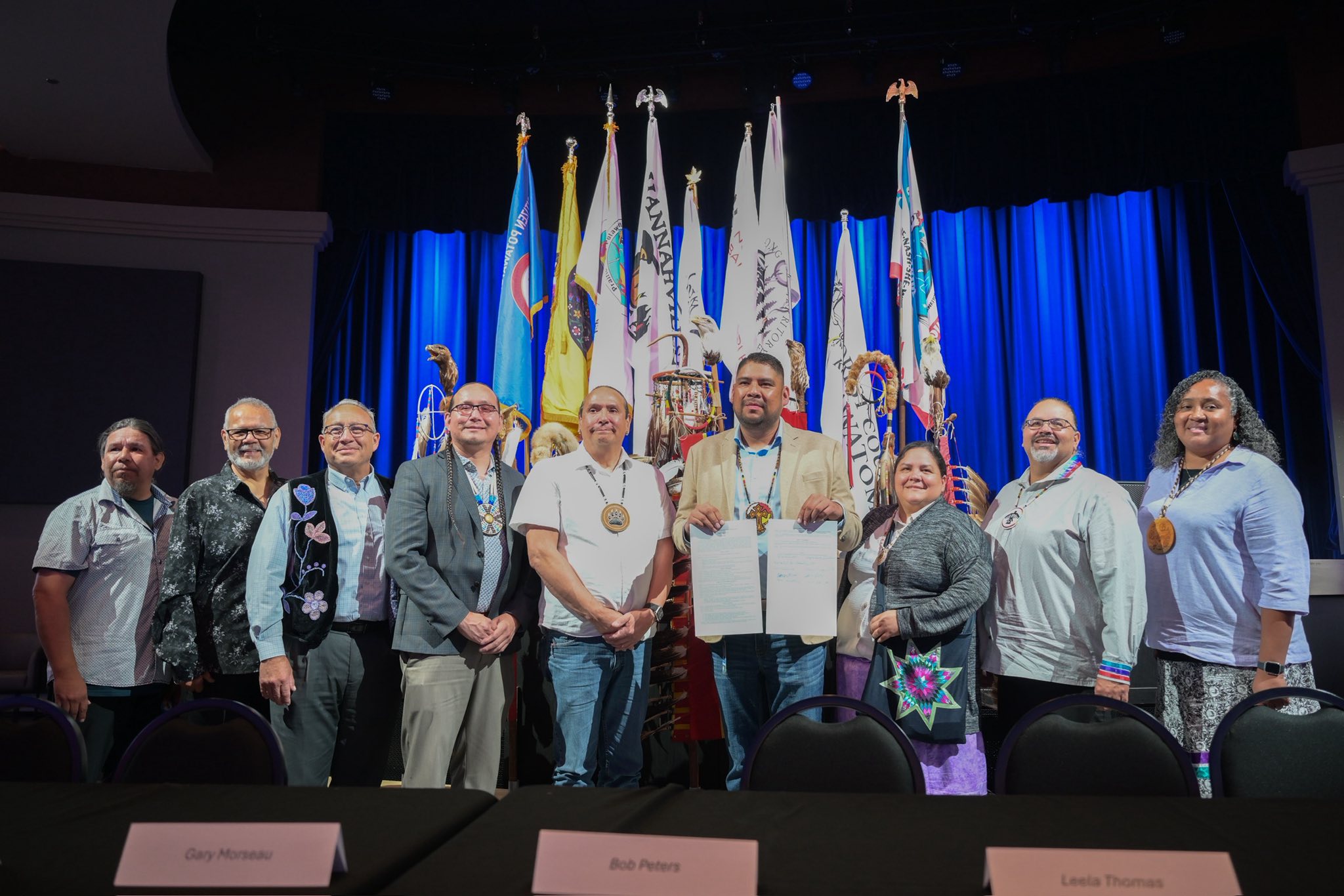
WAYLAND, Mich. — After decades of dialogue, the Bodéwadmi Confederation of Tribal Nations was formally established on Thursday during the 2025 Pottawatomi Gathering at the Gun Lake Casino Resort in Wayland, Michigan, as Potawatomi leaders came together to sign the Articles of Confederation.
The signing took place at the casino owned and operated by the Match-E-Be-Nash-She-Wish Band of Pottawatomi, commonly known as the Gun Lake Tribe, where the Potawatomi are gathering this week. .
[Editor’s Note: While most Potawatomi bands spell the name with one “t,” the Gun Lake Tribe uses two.]
Thursday’s historic signing follows a 2023 decision by Potawatomi leaders to form the confederacy, a vote that took place during that year’s Gathering, hosted by the Nottawaseppi Huron Band of the Potawatomi (NHBP).

The preamble of the Articles of Confederation begins with the words:
“We, the Bodewadmi Confederation of Tribal Nations (Confederation), in affirmation of our ancestral rights and defense of our inherent sovereignty, hereby establish this Confederation to secure our future as self-determined, self-governed tribal nations (Nations).”
The preamble continues stating that “the Nations of Confederation represent a diverse network of Bodewadmi that share the desire to work collectively toward furthering principles and polices that promote, defend, and enhance tribal sovereignty.
The Confederation consists of 12 tribal nations–with 8 of the 12–being the United States and four in Canada.
Article V of the Articles of Confederation: Powers and Responsibilities reads: “The Confederation shall promote and coordinate joint actions and initiatives among member Nations, including, but not limited to: economic development, environmental protections, cultural preservation, and political advocacy.”
Historically, by the early 1500s, the Potawatomi—also known as the Neshnabek or Bodéwadmi—had migrated from ancestral homelands along the Atlantic coast and around the St. Lawrence River into the Great Lakes region. They settled around Lake Michigan, establishing a presence across what is now southern Michigan, northern Indiana, northeastern Illinois, and southeastern Wisconsin
Over the next centuries, they flourished in these territories, forming a robust clan-based society governed by patrilineal lineage, with seasonal cycles of agriculture, hunting, fishing, and gathering.
However, European colonization in the 17th and 18th centuries—especially during the Beaver Wars and later U.S. expansion—disrupted their traditional lands. Through a cascade of treaties and forced removals,
The Potawatomi are known as the “Keepers of the Fire” because of their role within the Council of the Three Fires, a longstanding alliance among three closely related Anishinaabe nations: the Ojibwe, Odawa, and Potawatomi.
Currently, the Potawatomi tribes in the United States are located in Kansas, Michigan, Oklahoma, and Wisconsin. In Canada, the Potawatomi are located in Ontario.
Gun Lake Tribe Chairman Peters presided over the signing of the Articles of Confederation. Each signer of the Articles was given time to speak before signing the document. Several of the leaders became emotional due to the historic significance of forming the Confederation in modern times.
“Today was really historic; it was many years in the making—well before my time,” Peters said to Native News Online. “I’ve heard the stories from the chairmen of my tribe and my family. I attended Potawatomi Gatherings as a little guy. At the time, I didn't know what it was about. It felt like a large family reunion. But there’s a lot that goes into family reunions. It’s a lot of blood, sweat, and tears—literally—for all of us, the 12 Potawatomi tribes.”
Peters sees the formation of the Confederation as a means of economic development for the 12 tribes. However, it becomes more complex because there are Potawatomi communities in both the United States and Canada.
“Today’s signing now allows us to get things done by coming together with a strategy to move our nations forward with the federal government,” Peters said. “That can be achieved through numbers—by us coming together as a big group. There's power in numbers. There's power in the strength we Native Americans carry together. It runs in our blood. We're fierce. We're hunters. We're gatherers.”
For Prairie Band Potawatomi Nation Chairman Joseph “Zeke” Rupnick, the formation of the Confederation aligns with Peters’ vision. The opportunity for economic development is now stronger collectively.
“One of the hopes that we talked about initially is trying to use our buying power to effect change,” Rupnick said. “Meaning that every one of us—or almost all of us—has a casino. So can we come together, go to these vendors, and say, ‘Look, the Potawatomi are going to buy these machines, but you have to give us a better price’? We should use our buying power to benefit the whole nation.
“The same goes for those brothers and sisters up north on the border—to be able to re-establish those old trade routes, so we can start working back and forth with them. And whatever legislation we pass down here in the lower 48, we can use our influence to help shape legislation in their parliament, to help bring them back to a good playing field as well.”
During his remarks upon signing the Articles of Confederation, Hannahville Indian Community Tribal Chairperson Kenneth Meshigaud became emotional.
“We have wanted this day to come for decades. I have been chairman for almost 40 years, and we talked about it back then,” Meshigaud said.
“I wanted us to come together, and I helped and worked with people in the early days to get the Gatherings going and started. This is kind of the fruition of some of those efforts—to bring the community, the Potawatomi, back together as one nation. And I think the Federation’s Articles of Confederation just kind of solidified that. It made me so proud today.”
He added: “As Keepers of the Fire, it’s our responsibility to pass on the traditions and teachings of our culture to our people—whether they’re young, old, or somewhere in between. Everyone is an elder, and everyone has the ability to teach and become keepers of the fire. And the fire is within us—that’s what we have to continue.”
More Stories Like This
Committee Advances 20% Increase to Navajo Child Support GuidelinesNavajo Committee Advances $84M Transportation Improvement Plan
NCAI Passes Two Emergency Resolutions on Immigration Enforcement Activities
Chickasaw Lighthorse Police Officer named Indian Country Law Enforcement Officer of the Year
Indian Gaming Association Rallies Broad Coalition Against Sports Event Contracts It Calls Illegal Threat to Tribal Sovereignty
Help us defend tribal sovereignty.
At Native News Online, our mission is rooted in telling the stories that strengthen sovereignty and uplift Indigenous voices — not just at year’s end, but every single day.
Because of your generosity last year, we were able to keep our reporters on the ground in tribal communities, at national gatherings and in the halls of Congress — covering the issues that matter most to Indian Country: sovereignty, culture, education, health and economic opportunity.
That support sustained us through a tough year in 2025. Now, as we look to the year ahead, we need your help right now to ensure warrior journalism remains strong — reporting that defends tribal sovereignty, amplifies Native truth, and holds power accountable.
 The stakes couldn't be higher. Your support keeps Native voices heard, Native stories told and Native sovereignty defended.
Stand with Warrior Journalism today.
Levi Rickert (Potawatomi), Editor & Publisher