- Details
- By Levi Rickert
Opinion. On July 1, President Donald Trump visited a newly unveiled deportation facility in the Florida Everglades alongside Homeland Security Secretary Kristi Noem—the former South Dakota governor who was banned by tribal nations during her final year in office. The Trump administration has dubbed the site “Alligator Alcatraz.”
Ahead of his visit to Florida, Trump made a characteristically provocative remark. Referring to future detainees, he said, “We’re going to teach them how to run away from an alligator, okay? If they escape prison, how to run away.”
 Make A Monthly Donation Here
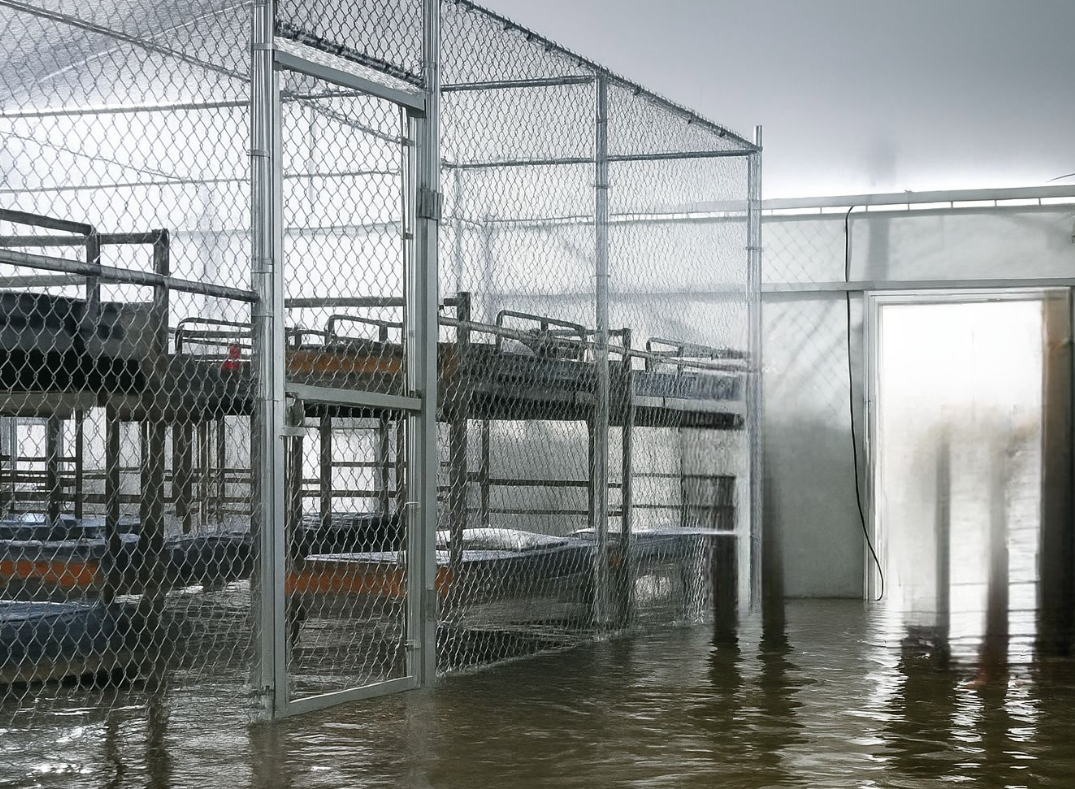
The detention center, with a projected annual operating budget of $450 million, has been constructed on a decommissioned airport runway in the Big Cypress region, approximately 37 miles west of Miami. Built in just eight days, the detention center now occupies the 11,000-foot-long airstrip and is designed to detain undocumented immigrants.
The makeshift complex consists of large tents, mobile trailers, and portable restrooms and showers. Electricity—including air conditioning—is supplied entirely by power generators. The site is secured by over 200 CCTV cameras, more than 28,000 feet of barbed wire fencing, and a force of 400 personnel drawn from both military and law enforcement agencies.
Planned as a modular facility, “Alligator Alcatraz” was built with scalability in mind. Initial capacity began at several hundred beds, with expansions already in progress to accommodate up to 5,000 detainees when fully operational.
The facility plays into Donald Trump’s personality — one that has always understood the power of spectacle. Throughout his political career, he’s leaned heavily on theatrical imagery to command attention, create controversy, and frame policy as performance. The so-called Alligator Alcatraz detention center epitomizes this type of optics where showmanship intersects with governance.
The portrayal of the facility fits neatly into the Trumpian narrative—one where cruelty is rebranded as strength, and impracticality becomes a feature, not a flaw, as long as it grabs headlines.
It feeds into a larger performance: Trump as the defender of American borders, willing to go to outrageous lengths to "protect" the nation. It reinforces the MAGA crowd's image of the John Wayne-type hero Trump wants to portray — one who places undocumented migrants among alligators and other wildlife, deliberately evoking Alcatraz, the long-closed notorious prison on a small island surrounded by the dangerous waters of San Francisco Bay.
But real power isn’t a circus act. Real power is about responsibility, about lifting people up, not tearing them down for applause. Trump’s showmanship often masks a lack of substantive policy, a disregard for facts, and a callous indifference for those most hurt by his actions.
While the optics play into Trump’s strong man routine, the numbers tell a different story. Despite the theatrical crackdown, the number of immigrants being deported have actually declined. Homeland Security spokesperson Tricia McLaughlin told The Washington Post last week that more than 239,000 migrants have been deported since the day Trump took office — far fewer than the 341,000 repatriated by the Biden administration from February through June last year.
So, it really is about the optics for Donald Trump.
But there’s something else that Trump’s spectacle ignores: whose land this actually is. While politicians posture over immigration policy, the real story is unfolding in the voices of the people who have called this place home for centuries — and who are watching their sacred lands be turned into a detention center without their consent.
The Florida Everglades have been home to the Seminole Tribe of Florida and the Miccosukee Tribe of Indians of Florida for centuries. Both federally recognized tribes oppose the facility’s location, but their governments were never consulted.
Betty Osceola, an elder of the Miccosukee Tribe and co-owner of Buffalo Tiger Airboats that operates in the Everglades, is opposed to the detention center. With a bullhorn in her hand, she led a group of protesters from her tribe and environmental organizations who protested in late June along U.S. Highway 41. One protester carried a sign that read: “Alligator Alcatraz is Florida’s Auschwitz.”
“I have serious concerns about the environmental damage,” Osceola told local reporters. “It’s disrupting the circle of life that these animals need.”
She fears the government’s claim that the facility is temporary; she believes it will operate for years.
On July 2, 2025, the Seminole Nation of Oklahoma joined the Florida tribes in protesting the new detention center. The tribe says the center insults their ancestral homeland and threatens the ecosystem.
Chief Lewis Johnson of the Oklahoma Seminole Nation said that Indigenous lands are not vacant but vital to their people.
"When we see these people that come in and want to oppress people of brown skin essentially and tell them they’re illegals, that doesn’t line up with us, because we don’t have this ideology of citizenship. No one should be illegal, because all this land has been stolen from us,” Johnson said.
Tribal governments were not consulted. Environmental warnings were ignored. This detention center isn't just bad policy — it's an affront to Native American treaty rights and trust obligations. South Florida's tribes deserve partnership, not more broken promises.
And migrants deserve compassion, not cages.
Thayék gde nwéndëmen - We are all related.
More Stories Like This
Colorado cannot heal until it confronts Sand Creek honestlyNative American Mothers Deserve to Live
Technology Rooted in Tradition is Strengthening Cherokee Nation
The Lumbee Tribe of North Carolina: #575
Tribes Do Not Need a Greenlight to Build Renewable Energy
Help us defend tribal sovereignty.
At Native News Online, our mission is rooted in telling the stories that strengthen sovereignty and uplift Indigenous voices — not just at year’s end, but every single day.
Because of your generosity last year, we were able to keep our reporters on the ground in tribal communities, at national gatherings and in the halls of Congress — covering the issues that matter most to Indian Country: sovereignty, culture, education, health and economic opportunity.
That support sustained us through a tough year in 2025. Now, as we look to the year ahead, we need your help right now to ensure warrior journalism remains strong — reporting that defends tribal sovereignty, amplifies Native truth, and holds power accountable.
 The stakes couldn't be higher. Your support keeps Native voices heard, Native stories told and Native sovereignty defended.
Stand with Warrior Journalism today.
Levi Rickert (Potawatomi), Editor & Publisher