Just hours after the beginning of the White House Tribal Nations Summit, President Joe Biden signed the historic $1.2 trillion Infrastructure Investment and Job Act. Among the crowd in the South Lawn of the White House were Navajo Nation President Jonathan Nez and Gila River Indian Community Governor Stephen R. Lewis. They joined members of the president’s cabinet, including Interior Secretary Deb Haaland (Laguna Pueblo), members of Congress, state governors, and local officials from around the United States.
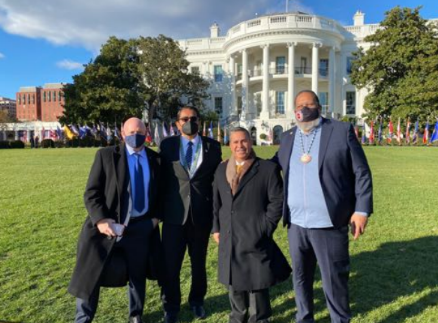
“It was truly an honor to be invited to the White House to represent the Navajo people for this monumental signing of the Infrastructure Bill. This measure will also fully fund the Navajo Utah Water Rights Settlement Act to provide much-needed water resources for Navajo people.” President Nez said.
Want more Native News? Get the free daily newsletter today.
The Investment and Jobs Act will rebuild America’s roads, bridges, and rails; expand access to clean drinking water; ensure every American has access to high-speed internet; tackle the climate crisis; advance environmental justice; and drive the creation of well-paying union jobs.
Major highlights of the Infrastructure Act for Indian Country are:
- Provides the Reclamation Water Settlement Fund with $2.5 billion to fully fund existing Indian Water Rights Settlements.
- Authorizes over $3 billion for the Tribal Transportation Program over five years with an additional $925 million for the Tribal Transportation Facility Bridges program (23 U.S.C. § 202(d)) over five years as supplemental appropriations.
- Authorizes $2 billion for the NTIA Tribal Broadband Connectivity Program and extends the deadlines for use of funds, removes the restriction that funds can only be used during the COVID-19 pandemic, and allows for new and subsequent funding rounds for additional appropriations.
- Provides $3.5 billion over five years for improvements and construction of IHS sanitation facilities under Indian Health Service Sanitation Facilities Construction Program.
- Provides $11.2 billion for grants to States and Tribes for abandoned coal mine land and water reclamation projects. Tribes with programs approved under Section 405 of the Surface Mining Control and Reclamation Act of 1977 are eligible to receive grants.
- Provides $55.426 billion for State and Tribal Assistance Grants for purposes of providing clean and safe drinking water to communities.
- Provides $6 billion for the Battery Material Processing Grant and Battery Manufacturing and Recycling Grant programs that will distribute grants with extra consideration given to eligible entities that partner with Indian tribes.
Not since President Dwight D. Eisenhower signed the Federal Aid Highway Act of 1956 that paid for 90 percent of the nation’s interstate highway system, has there been such a comprehensive piece of legislation to invest in the infrastructure of the United States.
More Stories Like This
Native News Weekly (August 25, 2024): D.C. BriefsUS Presidents in Their Own Words Concerning American Indians
Wounded Knee Massacre Site Protection Bill Passes Congress
Two Murdered on Colville Indian Reservation
NDAA passes House; Lumbee Fairness Act Advances
Help us defend tribal sovereignty.
At Native News Online, our mission is rooted in telling the stories that strengthen sovereignty and uplift Indigenous voices — not just at year’s end, but every single day.
Because of your generosity last year, we were able to keep our reporters on the ground in tribal communities, at national gatherings and in the halls of Congress — covering the issues that matter most to Indian Country: sovereignty, culture, education, health and economic opportunity.
That support sustained us through a tough year in 2025. Now, as we look to the year ahead, we need your help right now to ensure warrior journalism remains strong — reporting that defends tribal sovereignty, amplifies Native truth, and holds power accountable.
 The stakes couldn't be higher. Your support keeps Native voices heard, Native stories told and Native sovereignty defended.
Stand with Warrior Journalism today.
Levi Rickert (Potawatomi), Editor & Publisher