- Details
- By Native News Online Staff
Sand Creek Massacre National Historic site expanded through funds provided by the Land and Water Conservation Fund
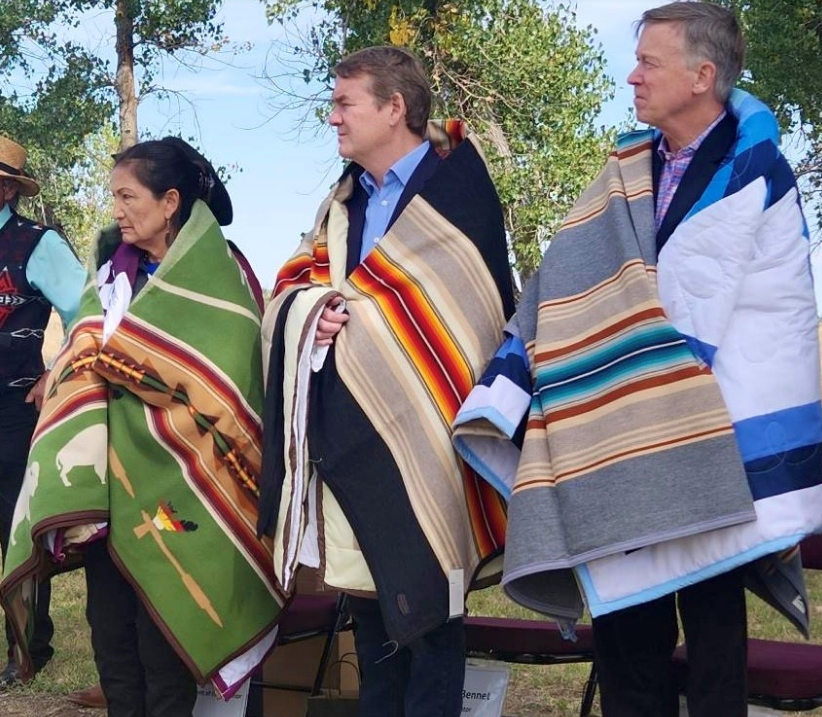
U.S. Secretary of the Interior Deb Haaland (Laguna Pueblo) and National Park Service Chuck Sams III (Umatilla) on Wednesday visited Sand Creek, the site of a brutal massacre that left 230 Native Americans dead in 1864, along with Colorado U.S. Senators Michael Bennet (D-CO) and John Hickenlooper (D-CO).
Joining the federal officials were leaders from the Northern Arapaho Tribe, the Northern Cheyenne Tribe, and the Cheyenne and Arapaho Tribes.

During the visit, it was announced that 3,500 additional acres will be added to the Sand Creek Massacre National Historic Site. This addition is made possible with financial support from the Land and Water Conservation Fund (LWCF).
The Sand Creek Massacre occurred on November 29, 1864, when U.S. soldiers attacked an encampment of approximately 750 Native people. The soldiers killed 230 people — mostly women and children. The Sand Creek Massacre National Historic Site was established in 2007 to preserve and protect the cultural landscape of the massacre and enhance public understanding of this horrific event.
“It is our solemn responsibility at the Department of the Interior, as caretakers of America’s national treasures, to tell the story of our nation. The events that took place here forever changed the course of the Northern Cheyenne, Northern Arapaho, and Cheyenne and Arapaho Tribes,” said Secretary Haaland. “We will never forget the hundreds of lives that were brutally taken here – men, women and children murdered in an unprovoked attack. Stories like the Sand Creek Massacre are not easy to tell but it is my duty – our duty – to ensure that they are told. This story is part of America’s story.”
“This is a long overdue step to respect and preserve land sacred to the Northern Cheyenne, Northern Arapaho, Cheyenne, and Arapaho Tribes,” Bennet said. “Today's ceremony is about remembering the atrocity at Sand Creek and honoring our government's continuing obligations to Tribal communities.”
The acquisition was made possible through funding from the LWCF. Since his arrival to the U.S. Senate, Bennet has championed LWCF, introducing legislation to fully fund the program in every Congress since 2010. In 2020, he introduced the bipartisan Great American Outdoors Act (GAOA) to permanently and fully fund LWCF. GAOA was signed into law in August 2020.
The land addition announced today will allow the NPS to increase public opportunities to experience and interpret the site’s stories and history. In addition, the expansion of the historic site will contribute to one of the most intact shortgrass prairie ecosystems within the National Park system, providing habitat for a wide range of plants, wildlife and species of special concern.
More Stories Like This
Native News Weekly (August 25, 2024): D.C. BriefsUS Presidents in Their Own Words Concerning American Indians
Haaland Meets with Southern New Mexico Law Enforcement on Public Safety Priorities
This Day in History – Dec. 26, 1862: 38 Dakota Men Executed by Order of Abraham Lincoln
Merry Christmas 2025
Help us defend tribal sovereignty.
At Native News Online, our mission is rooted in telling the stories that strengthen sovereignty and uplift Indigenous voices — not just at year’s end, but every single day.
Because of your generosity last year, we were able to keep our reporters on the ground in tribal communities, at national gatherings and in the halls of Congress — covering the issues that matter most to Indian Country: sovereignty, culture, education, health and economic opportunity.
That support sustained us through a tough year in 2025. Now, as we look to the year ahead, we need your help right now to ensure warrior journalism remains strong — reporting that defends tribal sovereignty, amplifies Native truth, and holds power accountable.
 The stakes couldn't be higher. Your support keeps Native voices heard, Native stories told and Native sovereignty defended.
Stand with Warrior Journalism today.
Levi Rickert (Potawatomi), Editor & Publisher