- Details
- By Native News Online Staff
The Navajo Nation is set to address longstanding chemical and petroleum contamination across its lands, targeting abandoned business sites and a significant former tribal enterprise in a mountainous region.
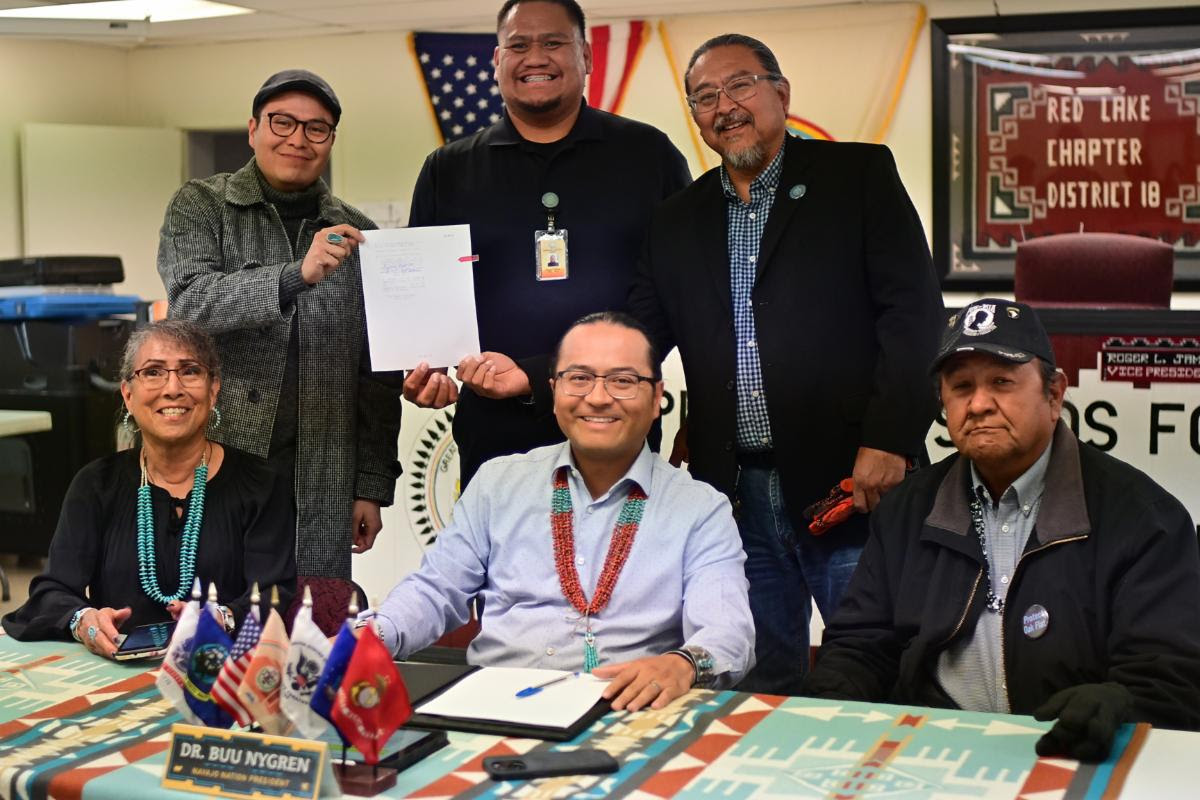
On Thursday, Navajo Nation President Buu Nygren praised Navajo EPA Director Stephen Etsitty and Council Delegate Andy Nez for their determination in securing the Navajo Environmental Remediation Fund's approval.

“I remember when Dr. Nez and Stephen came to my office,” he said. “They threw the number of $500 million that's going to be needed for remediation. I'm glad that we recognized the problem and now they've come up with the solution.”
The newly established Remediation Fund, signed into law by Nygren, marks the first step in working toward this goal. It allocates 2% of the Navajo Nation’s projected revenues from its general fund, which could grow the fund by about $4.4 million annually based on fiscal year 2026 forecasts.
Approximately 40 abandoned industrial and commercial sites across the Navajo Nation require environmental remediation. These sites include former trading posts, laundromats, gas stations, and the notably contaminated Navajo Forest Products Industries (NFPI) site in Navajo and Sawmill, New Mexico. Cleanup costs are estimated to exceed $47.6 million.
“This fund supports the clean-up of former businesses and industrial sites that sit empty or abandoned with contamination and pose a public health risk to Dine people, to natural resources like groundwater, and to livestock,” President Nygren said.
The NFPI site, originally established as the Nation's first tribally-owned enterprise, functioned as a sawmill and particle board facility. Built in Sawmill in 1939 and relocated in 1960, it closed in 1994, leaving contaminated soil and groundwater after years of operation. A 2021 soil assessment at the site detected high levels of harmful chemicals, including chromium, lead, diesel fuel, mercury, and solvents at varying depths. Groundwater tests also revealed hexavalent chromium, a known carcinogen.
While the fund's annual contributions won’t cover all estimated cleanup costs, Director Etsitty stressed the significance of this investment, which allows for the prioritization of contaminated sites. The Navajo EPA has already completed assessments and contamination removal efforts at multiple segments of the NFPI site, addressing asbestos and petroleum-contaminated soils.
Etsitty highlighted plans for site redevelopment, envisioning these locations transformed to meet community needs.
“Across our lands, that fulfills other needs in community locations for all manner of our society, from our children to our elderly,” he said. “So the land can be redeveloped. What was there before that came out of the 20th century can be redeveloped.”
The Remediation Fund will provide sustained financial support for long-term cleanup projects, reducing reliance on federal funding or lawsuit settlements. According to the legislation, the Controller’s office is expected to establish the fund by October 7, 2025, ensuring it can support the Navajo EPA’s cleanup operations at contaminated former business and industrial sites across the Nation.
“With this legislation, we are thinking for the future and building a healthier future for our people,” the President said.
The Navajo Nation is hopeful that, by investing in environmental remediation and redevelopment, they are paving the way for new community and economic opportunities over the next five to 15 years.
More Stories Like This
Southern Sierra Miwuk Nation Gets 900-Acres ofLand BackChilkat Indian Village Tells New Palmer Mine Owners They Are “Not Welcome” in Chilkat Valley
Tribes, Coastal Group Ask Army Corps to Revoke Permit for Texas Export Terminal
Michigan Tribes Tell Supreme Court: Don’t Bail Out Enbridge
Alaskans Raise More Than $1 Million For Communities Devastated by Typhoon Halong
Help us defend tribal sovereignty.
At Native News Online, our mission is rooted in telling the stories that strengthen sovereignty and uplift Indigenous voices — not just at year’s end, but every single day.
Because of your generosity last year, we were able to keep our reporters on the ground in tribal communities, at national gatherings and in the halls of Congress — covering the issues that matter most to Indian Country: sovereignty, culture, education, health and economic opportunity.
That support sustained us through a tough year in 2025. Now, as we look to the year ahead, we need your help right now to ensure warrior journalism remains strong — reporting that defends tribal sovereignty, amplifies Native truth, and holds power accountable.
 The stakes couldn't be higher. Your support keeps Native voices heard, Native stories told and Native sovereignty defended.
Stand with Warrior Journalism today.
Levi Rickert (Potawatomi), Editor & Publisher