A new nationwide study released by the National Native Scholarship Providers (NNSP) sheds light on the critical role that cultural affirmation, institutional support, and campus climate play in the success of Indigenous college students.
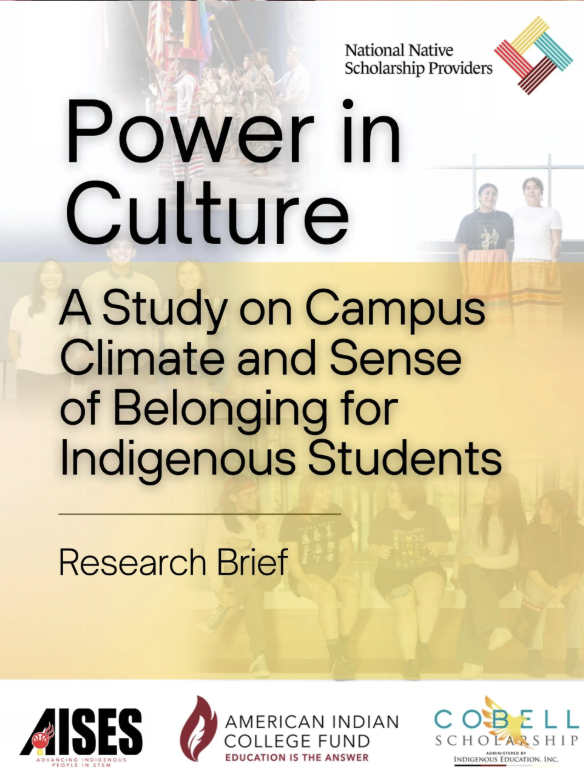
The study, titled “Power in Culture: A Study on Campus Climate and Sense of Belonging for Indigenous Students,” was developed through a collaboration between three NNSP members: the American Indian College Fund, the American Indian Science and Engineering Society (AISES), and Cobell Scholarship, Inc.
More than 560 Indigenous students across 184 colleges and universities took part in the survey, representing a wide range of institution types—including Tribal Colleges and Universities (TCUs), Predominantly White Institutions (PWIs), Hispanic-Serving Institutions (HSIs), and other Minority-Serving Institutions (MSIs).
Belonging Matters
The findings highlight a consistent theme: Indigenous students who experience a strong sense of belonging are more likely to remain enrolled and graduate. That sense of belonging is most strongly influenced by institutional support—students feeling accepted, included, and recognized for their identity.
“Institutional support is the most powerful driver of belonging, even in environments where formal inclusion policies are lacking,” the study states.
Tribal Colleges Lead the Way
Tribal Colleges and Universities ranked highest among institutions in fostering a sense of belonging, cultural affirmation, and community. The culturally responsive and student-driven atmosphere at TCUs was cited as a key factor.
Conversely, Indigenous students at non-TCUs reported challenges in feeling seen and supported. Many said they had to build their own support networks, while also facing higher levels of microaggressions, racial hostility, and social isolation. Students attending institutions with a larger Native student population reported a 14% stronger sense of belonging than those with fewer Native peers.
Surprising State-Level Trends
On a state level, the results revealed some unexpected findings. Students attending non-tribal colleges in states with large Native populations or existing TCUs reported a lower sense of belonging than students in other states. In fact, students in states with a TCU presence reported an 18% lower sense of belonging—highlighting complex systemic or contextual issues that require further study.
However, there was a silver lining: states that invested in higher education support for Native students saw a significant benefit. Each increase in state-level support corresponded to a 95% increase in a student's sense of belonging. Additionally, students living off-campus reported a 16.5% higher sense of belonging than those living on campus.
Long-Term Enrollment Patterns
The research also tracked the enrollment journeys of 654 Indigenous students over six years, beginning in Fall 2016. The data confirmed that many students follow non-linear paths—swirling between institutions, stopping out, and later returning. Attrition was highest in the early years, especially at institutions with limited cultural or institutional support.
In contrast, completion rates—especially two-year degrees—were notably higher at institutions like TCUs that offer culturally affirming environments and stronger support systems.
Six Core Factors of Belonging
The study identifies six interconnected factors that shape Indigenous students’ sense of belonging:
-
Institutional Support – Acceptance and inclusion by the institution.
-
Tribal Support – Connection to and support from tribal communities.
-
Family Support – Perceived familial support while enrolled.
-
Peer Support – Student relationships and group involvement.
-
Campus Climate – Inclusiveness and responsiveness to diversity.
-
Overall Sense of Belonging – Feeling valued, accepted, and supported.
Recommendations for Change
To address the gaps and improve outcomes, the study offers key recommendations:
-
Invest in peer mentorship and support programs—especially at non-TCUs.
-
Use culturally grounded tools to evaluate student experiences.
-
Recognize and support non-linear educational pathways.
-
Expand access to emergency financial aid as a retention strategy.
-
Prioritize identity-affirming spaces and programming in higher education.
The study underscores a powerful message: Indigenous students thrive in environments that honor their identity and heritage. As colleges and policymakers seek to improve equity in education, centering Indigenous voices and culture is not just beneficial—it’s essential.
More Stories Like This
Native Americans Could Be Hit Hard as Education Department Resumes Student Loan Wage GarnishmentHanging a Red Dress for Christmas: MMIP, Native Higher Education, and Hope for a Better New Year
Native Students Can Win $5,000 Scholarship, International Distribution in Pendleton Design Contest
American Indian College Fund Raises Alarm Over Plan to Shift Native Programs Away From the Dept. of Education
MacKenzie Scott Foundation Gives $5 Million Contribution to Little Priest Tribal College
Help us defend tribal sovereignty.
At Native News Online, our mission is rooted in telling the stories that strengthen sovereignty and uplift Indigenous voices — not just at year’s end, but every single day.
Because of your generosity last year, we were able to keep our reporters on the ground in tribal communities, at national gatherings and in the halls of Congress — covering the issues that matter most to Indian Country: sovereignty, culture, education, health and economic opportunity.
That support sustained us through a tough year in 2025. Now, as we look to the year ahead, we need your help right now to ensure warrior journalism remains strong — reporting that defends tribal sovereignty, amplifies Native truth, and holds power accountable.
 The stakes couldn't be higher. Your support keeps Native voices heard, Native stories told and Native sovereignty defended.
Stand with Warrior Journalism today.
Levi Rickert (Potawatomi), Editor & Publisher