



- Details
- By Chief Ben Barnes
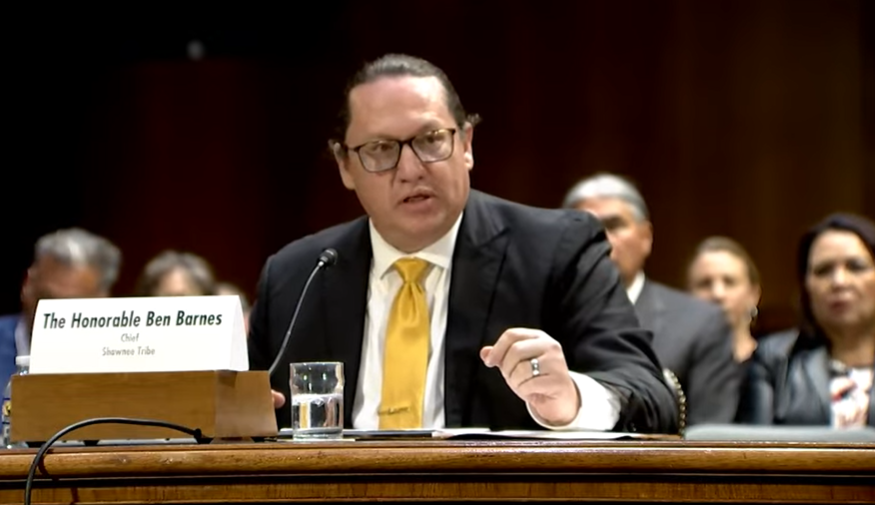
Guest Opinion. Last week, I was honored to testify before the Senate Committee on Indian Affairs on the matter of Lumbee recognition. I am grateful to Chair Lisa Murkowski (R-AK) for holding a serious, measured hearing — one that created space for actual evidence to be presented. This is long overdue.
But we did not only hear evidence that day. We also heard a great deal of emotion.
That is understandable. The Lumbee representatives deeply believe in what they are advocating. They spoke with conviction. They shared personal stories. They referenced many different stories, documents, historical eras, and even tribes. Yet in all of that testimony, one thing was never presented: not a single piece of evidence showing Lumbee descent from any historical tribe, and not a single piece of evidence that they were ever a historical tribal nation.

Emotion can tell us what people feel. Evidence tells us what is true. And sovereignty can only be protected by truth.
Emotion did not only come from the Lumbee witnesses. At one point, Senator Markwayne Mullin turned to the tribes testifying and said: “Turn around and look at the Lumbee. You can’t look at them and say they aren’t Native.” I respect Senator Mullin. But I disagree — and I thank him for unintentionally proving our point.
If we reduce sovereignty to “looking Native,” or to how a story makes us feel, then every tribe in this country becomes vulnerable to groups who assemble a narrative, stitch together a costume, or borrow the language of oppression. Identity becomes performance. Nationhood becomes aesthetics. And sovereignty becomes whatever someone can convince Congress to feel in a given moment.
For many years now, groups across the United States have attempted to appropriate the identities, histories, ceremonies, and cultural expressions of actual Tribal Nations. They cloak themselves in beads and feathers. They tell stories of oppression and neatly unprovable stories about “hiding out.” They adopt trauma as a credential. They do everything except produce actual historical evidence.
In the case of the Lumbee, the claims have gone even further. Some have fabricated boarding school narratives. As Chair of the National Native American Boarding School Healing Coalition, this crosses a line for me.
The historical record is clear. Nine individuals now held up in Lumbee narratives were rejected by the Carlisle Indian Industrial School because they did not meet the federal definition of Indian. They were only admitted after falsely claiming to be Cherokee. Independent genealogical review shows that not one of the nine had Native ancestry. Yet their descendants today identify as Lumbee.
This is not survivorship. It is an appropriation of trauma — trauma that Native families, including my own, are still healing from.
This hearing reminded me why, in the 1970s, tribal leaders asked the federal government to create a fair, consistent, non-political process for federal recognition. That is how the Office of Federal Acknowledgment came into being. The OFA process gives groups the opportunity to demonstrate nationhood with evidence. It evaluates petitions based on documented history, continuous community, genealogy, language, and governance — not political pressure, sympathy, or shifting sentiment.
It is not a perfect process, but it is currently the only process that protects legitimate Tribal Nations from fraudulent claims.
As Chief Hicks testified, “If there is evidence, let it be presented. If there is a tribe, the process will reveal it.” That is the only way to safeguard sovereignty.
If emotion, not evidence, becomes the measure for recognition, then Indian Country faces a future where sovereignty is decided by political momentum, where culture is redefined by outsiders, where sacred sites become vulnerable to competing claimants, and where treaty rights and resources are diluted by groups that never lived the histories they now claim.
Recognition must remain rooted in documents, history, genealogy, language, and continuity — not in sentiment or sympathy.
Anything else is a slippery slope from which tribal sovereignty may never recover.
For the sake of our ancestors, our children, and every Tribal Nation in this country, we must insist on a recognition process grounded in truth.
Ben Barnes is Chief of the Shawnee Tribe, Chair of the United Indian Nations of Oklahoma and Chairman of the Board for the National Native American Boarding School Healing Coalition.
Help us defend tribal sovereignty.
At Native News Online, our mission is rooted in telling the stories that strengthen sovereignty and uplift Indigenous voices — not just at year’s end, but every single day.
Because of your generosity last year, we were able to keep our reporters on the ground in tribal communities, at national gatherings and in the halls of Congress — covering the issues that matter most to Indian Country: sovereignty, culture, education, health and economic opportunity.
That support sustained us through a tough year in 2025. Now, as we look to the year ahead, we need your help right now to ensure warrior journalism remains strong — reporting that defends tribal sovereignty, amplifies Native truth, and holds power accountable.
 The stakes couldn't be higher. Your support keeps Native voices heard, Native stories told and Native sovereignty defended.
Stand with Warrior Journalism today.
Levi Rickert (Potawatomi), Editor & Publisher