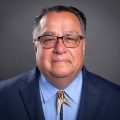
Opinion. Even after retiring from the U.S. Senate in 2005, former Sen. Ben Nighthorse Campbell, who passed away on Dec. 30, 2025, remained a familiar presence in Indian Country. He was easy to spot in the crowd — at White House Tribal Nations Conferences during the Obama administration, at the National Congress of American Indians State of Indian Nations address in Washington, D.C., and at Indian Gaming Association conventions.
By the time I founded Native News Online in February 2011, Campbell had been out of the Senate for six years. Until then, I knew him only through news accounts and books. I first met him at the Newseum in Washington, D.C., during a State of Indian Nations event. Handsome and dignified, he sat quietly as a steady stream of well-wishers stopped to greet him. I approached him with a sense of awe, regarding him as a Native statesman among tribal leaders. After all, he became the first Native American senator in more than six decades — a Northern Cheyenne man who served as one of 44 members of the tribe’s Council of Chiefs.
We exchanged business cards, and he told me Indian Country needed more news coverage and to keep going, adding that he appreciated my efforts.
In reality, I was the one who deeply appreciated his efforts during his service in Congress, both in the U.S. House of Representatives and the U.S. Senate. His career embodied a simple but powerful truth: Representation matters.
His legislative record spoke for itself. He co-authored the Indian Gaming Regulatory Act of 1988, one of the most consequential laws for tribal nations, a transformative measure that helped move some tribes from poverty to prosperity. In 1991, he also co-authored legislation renaming Custer Battlefield National Monument to Little Bighorn Battlefield National Monument, believing the original name reflected a one-sided and inaccurate telling of American history.
As the only Native American to chair the Senate Committee on Indian Affairs for more than half of his 12 years in the U.S. Senate, Campbell led bipartisan efforts to advance tribal sovereignty and expand access to health care, education and infrastructure in Native communities.
Campbell was a chief sponsor of the legislation that authorized and funded the Smithsonian’s National Museum of the American Indian on the National Mall, ensuring Native cultures and histories were honored in a major national institution.
He helped transform Great Sand Dunes National Monument into Great Sand Dunes National Park in southern Colorado. Campbell also worked on the creation of the Sand Creek Massacre National Historic Site, preserving a key site in American and Native history.
Campbell’s congressional efforts extended beyond Native American issues. In the 106th Congress, he ranked first among all senators and House members for passing the most standalone pieces of legislation into law, demonstrating his effectiveness in getting bills enacted.
Through his roles on the Appropriations Committee and other panels, he helped pass measures such as the Bulletproof Vest Partnership Act, improving safety for small police departments and tribal law enforcement agencies. Campbell also served on the Senate Veterans’ Affairs Committee, contributing to veterans policy.
In retirement, as an elder Native statesman among tribal leaders, he could have easily said, “Been there, done that.” Instead, he carried himself with quiet dignity, speaking when approached. For years, he and his wife, Linda, were guests of the Indian Gaming Association at its annual conventions. The late IGA Chairman Ernie Stevens, Jr. made certain the former senator was honored for his vast contributions to Indian gaming, recognizing that Campbell fought to preserve and strengthen Indian gaming even as it remained under constant attack after the Indian Gaming Regulatory Act was passed in 1988.
So, yes, I was in awe of Senator Campbell upon meeting him. I noticed when he talked he had a twinkle in his eye — which I took for him being a wise man. We developed a friendship that involved mutual respect through his latter years that allowed me to call him for opinions and background on issues. We shared common thoughts on the need to preserve tribal sovereignty and ensure progress is being made for Indian Country.
I was honored when he agreed to write the foreword to my book Visions for a Better Indian Country: One Potawatomi’s Opinions. In his first paragraph, he wrote, “Levi Rickert is a friend of mine. He is a man I respect and trust.”
By the second paragraph he made it clear that he and I did not agree on everything.
But, he wrote, “I agree with him 90 percent of the time. This is a good thing! In this day and age of canceling those who do not see things 100 percent our way, it is a very good thing that in Indian Country we can agree on most things and disagree on others, yet give our brothers and sisters the opportunity to speak their mind, and perhaps change our minds in the process.”
This nugget of wisdom is needed in this current age of polarization across the political spectrum.
After learning of Campbell’s death on Tuesday, I reread his words again. With his passing, the words became more meaningful to me than when I first read them.
On Saturday evening, I spoke with Dave Devendorf, who served as Senator Campbell’s chief of staff and remained close to him until his death. We agreed there will never be another Ben Nighthorse Campbell —a Native man who represented Indian Country with wisdom, dignity and that unmistakable twinkle in his eye.
Thayék gde nwéndëmen – We are all related.