



- Details
- By Professor Victoria Sutton
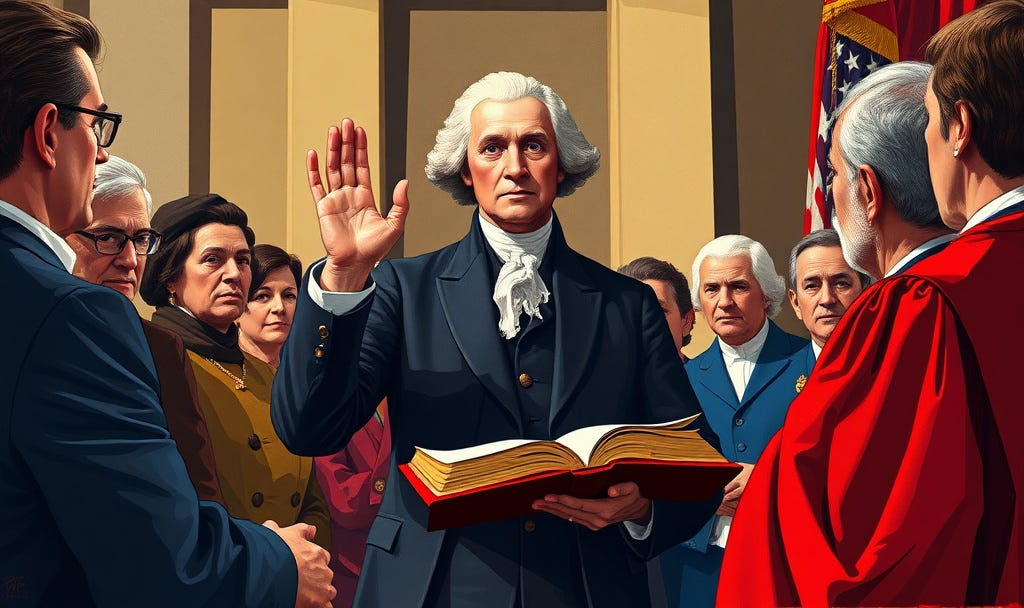
Guest Opinion.President’s Day, a federal holiday, falls around George Washington’s birthday, February 22, 1732. But it was not always February 22, 1732. At the time of his birth, he was born on February 11, 1731. When the U.S. changed from the Julian to the Gregorian calendar, his birth date became February 22, 1732.
This year, the 250th anniversary of the United States declaring its independence, there is much reflection on the pathway to electing a President. The creation of a President in the Constitution was not a given. Some even considered having two people serve as co-Presidents.
Much has been said about George Washington and his humble demeanor in refusing to take on the role of King.
He did turn down the role of King and went to great lengths to deny his interest in serving as President, but his humbleness is somewhat in dispute in the clever historical account of the election of 1789 by Marvin Kitman, entitled The Making of the Prefident 1789 (1989). He made quite a point, in his dry humor, of saying that using an “f” in the title instead of an “s” (as was the custom at the time) was proof that his book was historically accurate. Kitman’s historical research on George Washington’s election as President is admirable—and memorable.
We learn that Washington appeared wearing his uniform to Congress during the debate about who should be Commander in Chief of the Army, not just for one day but from May 24 to June 15, 1775. During that time, there was a rumor—never substantiated—that Colonel Washington offered to use his own wealth to raise an army of 1,000 men to defend Boston against what could be described as a British occupation. That seemed to give him even more momentum, without having to spend a penny.
After the Revolutionary War, George Washington was elected President of the “federal convention” that was to meet in Philadelphia and revise the Articles of Confederation. They ended up doing much more and kept it all secret until the release of the document to the newspapers. They knew the public might not tolerate such radical change, but here it was, and it came with the blessing of George Washington.
He ran unopposed for the Presidency.
Washington was so closely associated with the Constitution that ratification of the Constitution was almost synonymous with a vote for George Washington. He was so popular that no one ran against him, and when he was asked to run for a second term, he reluctantly accepted. When the chants of “four more years” began again (figuratively speaking) for a third term, he declined. The Constitution had not yet been amended to limit Presidents to two terms. It was not until after Franklin D. Roosevelt’s fourth term—when he died in office—that Congress proposed a constitutional amendment to limit the President’s terms to two.
The election of 1789 was surprisingly like most elections. There was a campaign. However, traditional handshaking was not in George Washington’s set of campaign tools. Historians say he stood by the fireplace and “received visitors with a courtly bow.” According to historians, he believed a handshake was beneath his dignity.
While there could have been scandals about misspent public funds in the Army and rumors of indiscretions, there were none that shook the campaign.
The President was elected by the Electoral College, and there were to be 72 electors from ten states. The ballots were cast on February 4, 1789, and opened on April 6. Washington received 100% of the electoral votes—69 (three did not appear). According to Kitman, the Secretary of Congress, Charles Thomson, rode his horse to Mount Vernon to tell George Washington that he had been elected President on April 14, at about 1:00 p.m. He wrote:
“Sir, The President of the Senate chosen for the special occasion having opened and counted the votes of the Election in the presence of the Senate and House of Representatives, I was honored with the commands of the Senate to wait upon your Excellency with the information of your being elected to the office of Prefident of the United States of America…”
George W. Bush (“43”) was once asked to write about George Washington for the 250th anniversary of the United States. He said it was Washington’s humility that most impressed him. Despite George Washington’s overt, almost Instagram-like behavior of wearing his uniform every day to Congress while everyone looked around the room for the next Commander in Chief, I agree—at least that he was employing a humility strategy.
Remarkably, the country followed the process outlined in the Constitution, fresh off the press. Establishing three branches of government followed, with some tensions among them as they determined where the lines were drawn (we are still working on that). George Washington considered it a “miracle” and told Lafayette on February 7, 1788:
“It appears to me, then, little short of a miracle, that the Delegates from so many different States (which States you know are also different from each other), in their manners, circumstances, and prejudices, should unite in forming a system of national Government, so little liable to well-founded objections.”
George Washington had flaws, and I acknowledge that the Father of our Country was far from perfect. But he seems to have been the right person for the time—the leader who graciously gave much of his life to the service of his country at critical points in our history. Presiding over the “miracle” of a Constitution, with agreement from the states followed by ratification, is still impressive. Launching a non-candidate-style campaign for President, running unopposed, and winning is impressive as well. For that, he deserves our thanks and a happy birthday on his actual birthday, February 22, 1732 (with calendar adjustments for the Gregorian calendar, of course!).
To read more articles by Professor Sutton go to https://profvictoria.substack.
Professor Victoria Sutton (Lumbee) is a law professor on the faculty of Texas Tech University. In 2005, Sutton became a founding member of the National Congress of American Indians, Policy Advisory Board to the NCAI Policy Center, positioning the Native American community to act and lead on policy issues affecting Indigenous communities in the United States.
Help us defend tribal sovereignty.
At Native News Online, our mission is rooted in telling the stories that strengthen sovereignty and uplift Indigenous voices — not just at year’s end, but every single day.
Because of your generosity last year, we were able to keep our reporters on the ground in tribal communities, at national gatherings and in the halls of Congress — covering the issues that matter most to Indian Country: sovereignty, culture, education, health and economic opportunity.
That support sustained us through a tough year in 2025. Now, as we look to the year ahead, we need your help right now to ensure warrior journalism remains strong — reporting that defends tribal sovereignty, amplifies Native truth, and holds power accountable.
 The stakes couldn't be higher. Your support keeps Native voices heard, Native stories told and Native sovereignty defended.
Stand with Warrior Journalism today.
Levi Rickert (Potawatomi), Editor & Publisher