- Details
- By Elyse Wild
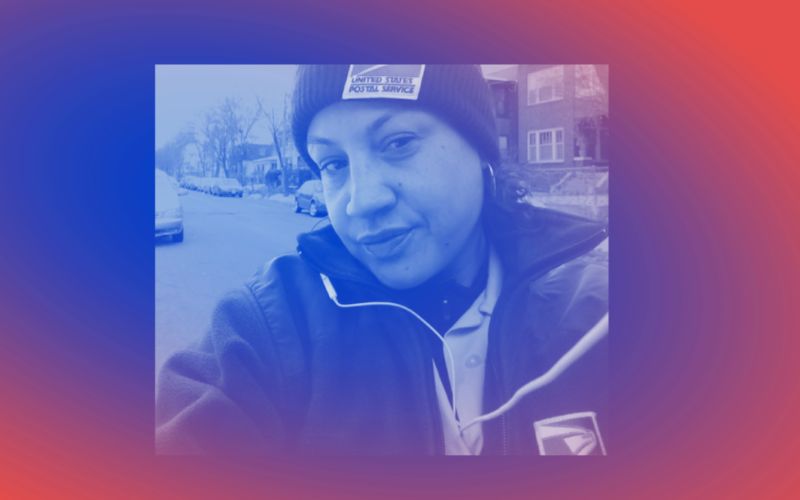
Bianca Sonnenberg’s uniform has become her security blanket. Before ICE arrived in Minneapolis, she would change when she finished her route.
Editor's Note: This story was originally published in Mother Jones.
Recently, she’s hoped her identity as a US Postal Service worker would protect her from getting targeted by ICE operations. She’s Native American, and over the last few months, she’s heard about ICE detaining Indigenous people in Minneapolis and around the country. It terrifies her.
White House border czar Tom Homan announced today that the Department of Homeland Security will end Operation Metro Surge after months of chaos resulting in DHS claims of more than 4,000 arrests, the killings of Alex Pretti and Renée Good, and immense community resistance.
Sonnenberg spoke to Mother Jones's podcast Reveal about the big and small changes she and her colleagues witnessed along their routes in South Minneapolis during the disruptive operation. She spoke from her personal perspective and not as a representative of the USPS.
Her story has been edited and condensed for clarity.
As mail carriers, when we’re on our route for a long time, you start to know your community, so you memorize names. And a co-worker was like, “Alex Pretti’s on my route.”
And so I was like, “Oh my gosh.” He was like, “Yeah, they got a little memorial out there. I feel so bad. He has packages today.”
That almost made tears come to my eyes. It’s so sad how you’re here one second and you’re just gone the next. And you don’t think about that when you are ordering a package. You don’t think, “Oh, I’m not gonna be here to get my package.”
It’s really sad that he was taken and he did nothing wrong. I’ve seen the videos, and he didn’t do anything wrong. He didn’t reach for any gun and all the stuff that they’re trying to make him seem like. First of all, they were calling him an assassin…but then it’s, “We gotta go through a full investigation.” How can you say that?
I feel grateful that I got this privilege of being a federal employee. In the daytime, I can go to the store; I can move about my community and not feel like they’re gonna bother me, per se. But I wear my uniform home because I’m too scared not to. I could be targeted.
My mindset is let me get what I need from the store or whatnot before I come home. Because God forbid somebody pulls the Uber driver over and I don’t have my uniform on. I run into the store before I get home, and there’s an operation on the block that I wasn’t paying attention to. I get caught up and they slam me around a little. I’m fragile. I’m 49 years old. I can get bruised. I bruise easily. I don’t want to go through that.
It’s crazy, because I always say I only fear God, but they have definitely triggered something in me to be more protective of myself and of my surroundings and the people that I care about, including other people on my route.
I’ve been around them for over a decade. Most of them have all been on my route the whole time. So we’re a big village.
Our supervisor let us know (on January 24) that ICE had killed somebody close to the route. She said it happened in front of Glam Doll Donuts. I was like, “Oh my God, that’s my block.”
More Stories Like This
Native News Weekly (August 25, 2024): D.C. BriefsUS Presidents in Their Own Words Concerning American Indians
Next on Native Bidaské: Inside Dark Winds with the Cast of Season 4
'Sovereignty Predates the United States,' NCAI President Mark Macarro Tells Tribal Nations
Help us defend tribal sovereignty.
At Native News Online, our mission is rooted in telling the stories that strengthen sovereignty and uplift Indigenous voices — not just at year’s end, but every single day.
Because of your generosity last year, we were able to keep our reporters on the ground in tribal communities, at national gatherings and in the halls of Congress — covering the issues that matter most to Indian Country: sovereignty, culture, education, health and economic opportunity.
That support sustained us through a tough year in 2025. Now, as we look to the year ahead, we need your help right now to ensure warrior journalism remains strong — reporting that defends tribal sovereignty, amplifies Native truth, and holds power accountable.
 The stakes couldn't be higher. Your support keeps Native voices heard, Native stories told and Native sovereignty defended.
Stand with Warrior Journalism today.
Levi Rickert (Potawatomi), Editor & Publisher