



- Details
- By Native StoryLab
A new Brookings Institution report warns that President Donald Trump’s “One Big, Beautiful Bill Act” (OBBA) could cost Indian Country billions in lost green energy investment while weakening access to SNAP and Medicaid, despite Native-specific exemptions written into the law.
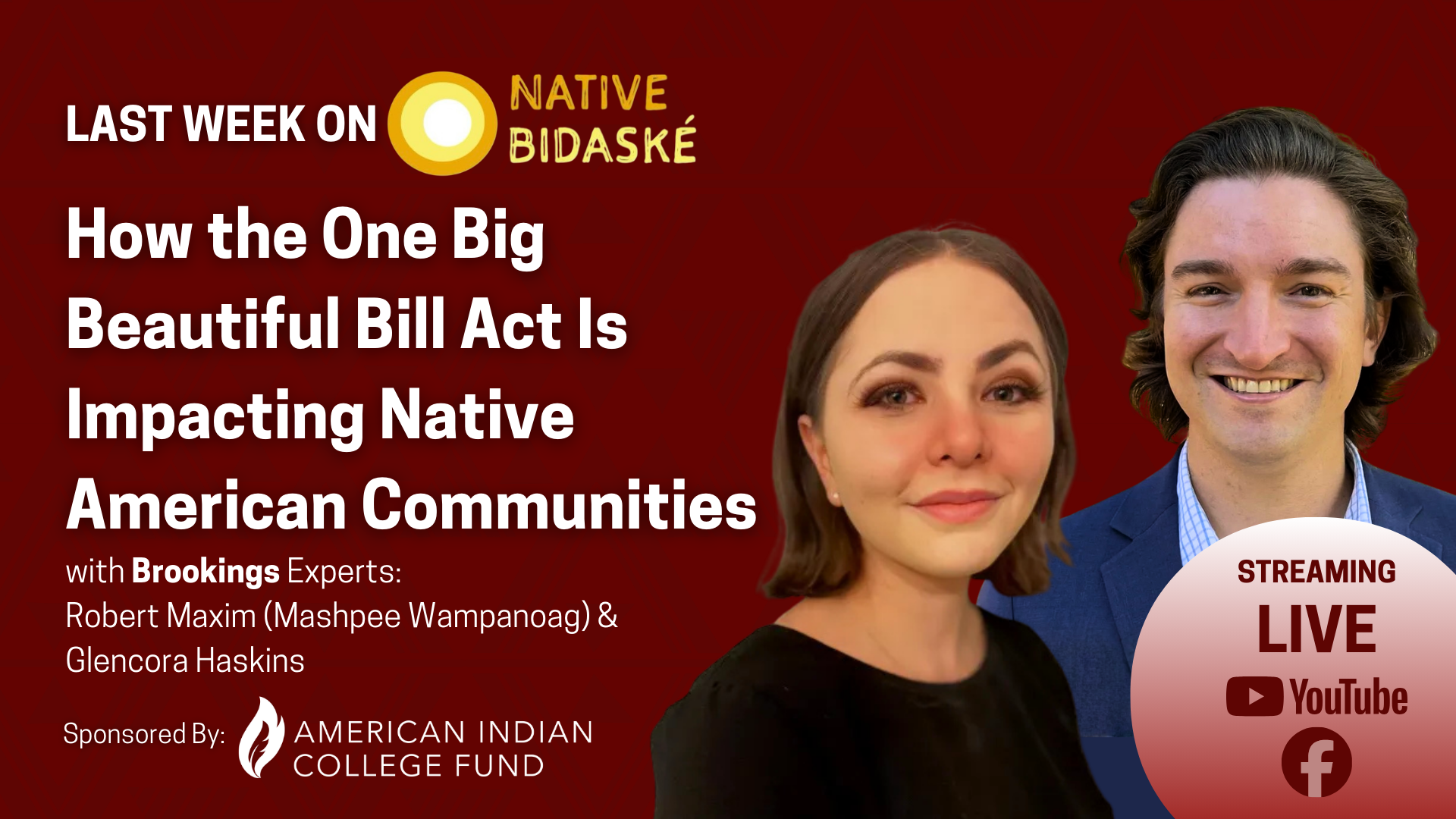
On the latest episode of Native Bidaské, Native News Online editor and publisher Levi Rickert spoke with report authors Rob Maxim and Glencora Haskins about how OBBA repeals key Inflation Reduction Act (IRA) programs and why Native communities remain vulnerable even when carve-outs exist on paper.
Why Brookings Analyzed OBBA’s Impact on Native Communities
Haskins said the report addresses a significant gap in federal policymaking: the lack of data quantifying the impact of sweeping legislation on Indian Country.
“It was widely understood that the One Big, Beautiful Bill Act would impact Indian Country,” Haskins said. “But even now, there’s been very little ability to quantify that impact.”
While OBBA preserves some Native-specific exemptions and programs, she emphasized that most federal funding reaching Native people does not come from tribal set-asides.
“Exemptions to work requirements are not always foolproof,” she said. “We wanted to offer one of the first looks at what OBBA could really mean for Native people living on and off reservations.”
How Indian Country Could Lose $1.5 Billion in Green Energy Funding
Rickert asked how the report arrived at its estimate that Indian Country could lose $1.5 billion in future green energy funding.
Maxim explained that OBBA repealed or rescinded major climate provisions from the Inflation Reduction Act—the largest federal investment in climate and clean energy in U.S. history.
Using federal spending data, Brookings tracked IRA funding that has already been awarded to tribes, Native-owned entities, and tribal institutions.
“About $2 billion had already flowed to Indian Country through IRA programs that were later targeted for repeal,” Maxim said.
If those programs had remained in place through their scheduled expiration—some through 2027, others through 2031—Indian Country could have received an additional $1.5 billion.
“Because of OBBA, many of those funding sources are now cut off entirely,” Maxim said.
Why Cutting Broad-Eligibility Programs Hits Native Communities Hard
Both authors stressed that broad-eligibility federal programs, not tribal-only initiatives, deliver the majority of resources to Native communities.
Haskins pointed to SNAP as a clear example. “The majority of food benefits received by Native people come through SNAP,” she said. “It’s not a Native-targeted program, but it’s still the primary source of food support for food-insecure Native Americans.”
The same pattern applies to climate funding, she said, where programs like the Greenhouse Gas Reduction Fund—open to states, cities, and tribes—have delivered more support than smaller tribal-specific programs.
“It’s not sufficient to leave tribal-serving programs on the books and assume cutting other programs won’t hurt Indian Country,” Haskins said.
SNAP, Medicaid, and the Cost of Tax Cuts
Maxim said OBBA’s new work requirements for SNAP and Medicaid are central to how the bill offsets its tax cuts.
“One of the most significant sources of cost savings comes from these work requirements,” he said. “The bill is designed around people losing coverage.”
Because Native Americans rely on SNAP and Medicaid at some of the highest rates in the country, Indian Country is particularly exposed—even with exemptions written into law.
“Exempting someone on paper is not the same as exempting them in real life,” Maxim said.
When Policy Meets Reality in Indian Country
Rickert asked about the disconnect between legislation and lived experience. Maxim said the core divide in policymaking for Indian Country is not partisan.
“The real divide is between policymakers who don’t understand how programs work in Indian Country and those who do,” he said. He cited barriers such as limited access to tribal ID offices, long travel distances, and processing delays—factors that can leave families without food or health coverage for weeks. “Two or four weeks might not seem like much in Washington,” Maxim said, “but for a family trying to put food on the table, that gap is enormous.”
Haskins added that limited broadband, lack of street addresses, and poor data collection make it even harder to track who is being disenrolled and why.
This episode of Native Bidaské was sponsored by the American Indian College Fund, the nation’s largest Native-led and Native-serving charity dedicated to expanding access to higher education for American Indian and Alaska Native students. Sponsorship does not affect editorial coverage.
Watch the full conversation on our Facebook, YouTube, and NativeNewsOnline.net.
Help us defend tribal sovereignty.
At Native News Online, our mission is rooted in telling the stories that strengthen sovereignty and uplift Indigenous voices — not just at year’s end, but every single day.
Because of your generosity last year, we were able to keep our reporters on the ground in tribal communities, at national gatherings and in the halls of Congress — covering the issues that matter most to Indian Country: sovereignty, culture, education, health and economic opportunity.
That support sustained us through a tough year in 2025. Now, as we look to the year ahead, we need your help right now to ensure warrior journalism remains strong — reporting that defends tribal sovereignty, amplifies Native truth, and holds power accountable.
 The stakes couldn't be higher. Your support keeps Native voices heard, Native stories told and Native sovereignty defended.
Stand with Warrior Journalism today.
Levi Rickert (Potawatomi), Editor & Publisher