Overview:
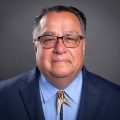
Democratic U.S. Senate nominee Abdul El-Sayed visited Saginaw Chippewa Tribal College to discuss tribal sovereignty, health care access, environmental protection and civil rights with Michigan’s Native communities, joined by U.S. Sen. Mark Kelly and former Rep. Gabby Giffords.
Native Vote 2026
ISABELLA INDIAN RESERVATION, Mich. — Fresh off a contentious debate with Republican U.S. Senate candidate Mike Rogers, Dr. Abdul El-Sayed, the Democratic nominee for U.S. Senate in Michigan, brought his campaign to Saginaw Chippewa Tribal College on Friday to reach Native American voters.
Joining El-Sayed on the campaign trail were former U.S. Rep. Gabby Giffords and her husband, U.S. Sen. Mark Kelly (D-Ariz.), who has been mentioned in national media as a possible presidential candidate in 2028.
The event centered on El-Sayed’s campaign for the open U.S. Senate seat held by retiring Sen. Gary Peters. El-Sayed discussed his race against Rogers and his efforts to build solidarity with Michigan’s Native communities around health care, tribal sovereignty, environmental protection and economic dignity.
While campaigning, El-Sayed said he often finds himself in the back of an SUV, but one campaign stop has stood out to him: his visit to the Bay Mills Indian Community in Michigan’s Upper Peninsula.

“One of the most important memories to me were opportunities to spend time up with Bay Mills Tribe, to be invited to sweat in the lodge, to be gifted a ceremonial drum, to hear exactly what it meant to protect the Great Lakes from people whose lives are about protecting the Great Lakes,” El-Sayed said.
El-Sayed was referring to the Bay Mills Indian Community’s longstanding opposition to Enbridge’s Line 5 pipeline, which runs through the Straits of Mackinac, part of the tribe’s ancestral lands and waterways.
In a statement to Bridge Michigan, El-Sayed called for “a responsible shutdown of Line 5 in its current form.” He also said a more robust environmental review was needed than the one the Trump administration “rammed through.”
El-Sayed also spoke about the importance of access to quality health care for everyone.
He said he learned at Bay Mills about “folks trying to get an appointment at IHS to understand what it’s like to watch your tribal sovereignty be disrespected and discounted over and over and over again.”

“In communities like this, it is easy to talk to specific issues, but what I’m trying to do is build something where we build a solidarity around what we deserve together, and and I think that’s the lesson because you could you could be on a reservation, you could be in a church in Detroit, you could be in a living room in Lansing, you need healthcare.”
El-Sayed also discussed traveling to Minneapolis during the height of Operation Metro Surge, following the killings of Renee Good and Alex Jeffrey Pretti, both 37 and U.S. citizens, by federal law enforcement officers.
“I got to sit down with tribal leaders who were talking about watching as folks in their community were being detained because they share the same skin color as folks who just immigrated here,” El-Sayed said.
“Imagine ICE detaining folks who’ve been here since before this place was called America at the edge of immigration enforcement, and it’s just a reminder that too often the edifices that we build, too often the the way that we allow power to to decide what we can and cannot have that it comes for us and that our fight around liberty around freedom around the basic means of a dignified life we have an opportunity to build that together.”
During his remarks, Kelly, who represents Arizona, said Native Americans in his state face problems similar to those experienced by Native people elsewhere, including being questioned or detained because of their skin color.

“We have the same thing. Obviously, we’re close to the border. Not too long ago, I saw a tribal member getting pulled over by Border Patrol and trying to tell a Border Patrol agent, ‘Hey, my family, my family has been here for thousands of years, and you’re asking me if I have a right to be here,’” Kelly said.
“We have over 300,000 tribal members in Arizona that this administration does not respect. It does not respect tribal sovereignty. It does not understand that, especially in Arizona, tribal water rights are so critical for the success of these communities,” Kelly said.
Kelly invited his wife, former Rep. Giffords, to the podium. Giffords survived a horrific violent attack while hosting a public meeting in Tucson, Ariz. A gunman killed six people, including a 9-year-old girl and a federal judge, and wounded 13 others. Giffords survived but suffered a severe brain injury and later resigned from Congress to focus on her recovery.

“I responded with grit and determination. I put one foot in from the other. I found one word and then I found another. My recovery is a daily fight, but fighting makes me stronger. Words once came easily. Today I struggle to speak, but I’ve not lost my voice,” Giffords said. “America needs all of us to speak out, even when you have to fight to find the words. I’m also in the second fight, the fight to stop gun violence. It’s also a fight forged by tragedy and pain, a fight that can change lives. We are at a crossroad. We can let shooting continue, or we can act.”
The couple spoke in favor of the need to elect El-Sayed to the United States Senate.
There are over 100,000 Native Americans above 18 years of age who are eligible to vote in Michigan.
The event was organized by Blue Action Native Vote.